Book Review: Dr. Alfredo Quinones-Hinojosa’s “Becoming Dr. Q: My Journey from Migrant Farm Worker to Brain Surgeon”

As a young boy in Mexico, Dr. Alfredo Quiñones-Hinojosa admired Kalimán, a comic book character with superhero-like abilities.

Quiñones-Hinojosa has demonstrated the same abilities in his lifetime – jumping over a fence to get into the United States, working his way through college and medical school and becoming one of the top brain surgeons in the country – which he writes about in his autobiography Becoming Dr. Q: My Journey from Migrant Farm Worker to Brain Surgeon (University of California Press).

Quiñones-Hinojosa grew up in Mexicali, showing precocious leadership and academic skills at a young age. He came from a loving, but poor, family that endured the death of one child and worked in the fields of California. Believing he could make more money for his family, Quiñones-Hinojosa crossed the border illegally on his 19th birthday in 1987 – an event that makes for the book’s most riveting chapter.

The laws at the time made it possible for Quiñones-Hinojosa to obtain legal status and, eventually, his citizenship. His hard work and determination drove him to study at the University of California at Berkeley while working as a welder. Inspired by his curandero grandmother and his own desire to help others, he got into medicine, and he was accepted into Harvard Medical School.

“Two gears still drove me forward,” he writes. “One was for the dreamer and optimist in me who imagined, as I had from childhood, that I was destined to live forever. But the other was for the part of me that realized that life could be snatched away at any moment and felt I had to work hard at everything, as if each day were my last to live.”

Quiñones-Hinojosa goes through his residency while working on weekends and raising a young family – and he survives a few brushes with death. But the hard work pays off. He lands a job at Johns Hopkins Medical Center, one of the most prestigious medical institutions in the nation. He was featured on the ABC documentary Hopkins and PBS’s Nova.

Quiñones-Hinojosa, along with co-author Mim Eichler Rivas, writes in a matter-of-fact tone without sounding sorry for himself or arrogant. The fast-paced book is most intriguing when he writes about his early life. The last third of the book focuses on his medical cases, but it doesn’t get too technical and is easy to understand.

This book will appeal to almost everybody, but it should make its way to the hands of young Hispanics, who will hopefully make Dr. Q their own Kalimán.
More about Dr. Alfredo Quiñones-Hinojosa:

• The University of California Press posted an excerpt of the book here, which describes his baby sister’s death.

• Fox News Latino has an excellent article about Dr. Q. He also discussed his book on C-SPAN.

Leave a comment

Filed under 2011 Books, Book Reviews, Non-Fiction

Happy Birthday, Carlos Fuentes!

Update: Carlos Fuentes passed away in May 2012. Here’s his obituary from The New York Times and a remembrance from his friends Alberto Manguel and Liz Calder in The Guardian.

Fuentes, perhaps Mexico’s best known writer, turns 83 today. Along with Columbian Gabriel Garcia Marquez and Peruvian Mario Llosa Vargas, he was part of the Latin American boom in literature in the 1960s and 1970s. Encyclopedia Britannica has his biography here.

His best known books are 1962’s The Death of Artemio Cruz, about an dying soldier looking back on his life, and 1985’s The Old Gringo, the story of an American writer in the Mexican revolution that was made into a 1989 movie with Gregory Peck, Jane Fonda and Jimmy Smits.

Here’s some clips of Fuentes on The Charlie Rose Show.

In this article for the Latin American Herald-Tribune, Fuentes discussed the history of Latin American literature.

Leave a comment

Filed under Author Profiles

Book review: José Saramago’s “Cain”

Nobel Prize winner José Saramago is known for his dark words such as Blindness. Who knew he was such a comedian?

The late Portuguese’s last novel, Cain, released last month, tells some of the stories of the Bible from the perspective of Adam and Eve’s son, Cain, who killed his brother, Abel, out of jealousy. After the murder, Cain witnesses historical events from the Bible – the destruction of Sodom and Gomorrah, the creation of the golden calf and the construction of Noah’s Ark.

Through it all, Saramago offers some wry observations – such as when Eve complains about having diarrhea. “What’s diarrhea, asked the angel, Another word for it is the runs, the vocabulary the lord taught us has a word for everything, having diarrhea or the runs, if you prefer that term, means that you can’t retain the shit you have inside you.”

Or this, when Abraham is asked to sacrifice his son, Isaac: “The logical, natural and simply human response would have been for abraham to tell the lord to piss off, but that isn’t what happened.”

(By the way, Saramago doesn’t capitalize names or use quote marks in the book.)

Of course, Saramago, who was known for his atheist views, is mocking the Bible. Cain frequently questions the Lord’s motives in killing thousands of innocent lives during the destruction of Sodom and Gomorrah and the Golden Calf. Fans of Kurt Vonnegut and Christopher Hitches will love this stuff.

Saramago writes in never-ending sentences and never-ending paragraphs that may have some readers rereading passages. But, at 159 pages, Cain is a quick read and, considering the complexity of his other books, this may be a good starting point for his work.

More about José Saramago:

Saramago won the Nobel Prize for Literature in 1998. The Nobel’s website includes this biography.

Margaret Jull Costa, who translated Cain and Paulo Coelho’s recent book Aleph, wrote about him in this article for Granta magazine.

1 Comment

Filed under 2011 Books, Author Profiles, Book Reviews

In the news

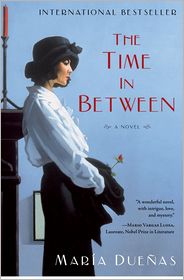
New releases: Maria Duenas’s The Time in Between comes out Tuesday. The suspense novel has received great reviews, including a blurb from Nobel Prize winner Mario Vargas Llosa.  News for all the People: The Epic Story of Race and the American Media, by Juan Gonzalez and Joseph Torres, came out last month.

 • Book festivals: The Miami Book Fair International begins Nov. 13 and runs through Nov. 20, with the street fair running from Nov. 18-20. One session includes Francisco Goldman, Elizabeth Nunez, Esmeralda Santiago and Héctor Tobar – all in one room! Other writers include Ricardo Cravo Albin, Jose Alvarez, Sandra Rodriguez Barron, Jorge Casteñada, Maria Duenas, Christina Diaz Gonzalez, Martha Medeiros, Ana Menendez, Javier Sierra, Justin Torres, Ian Vasquez and Luis Alberto Urrea. Awesome.

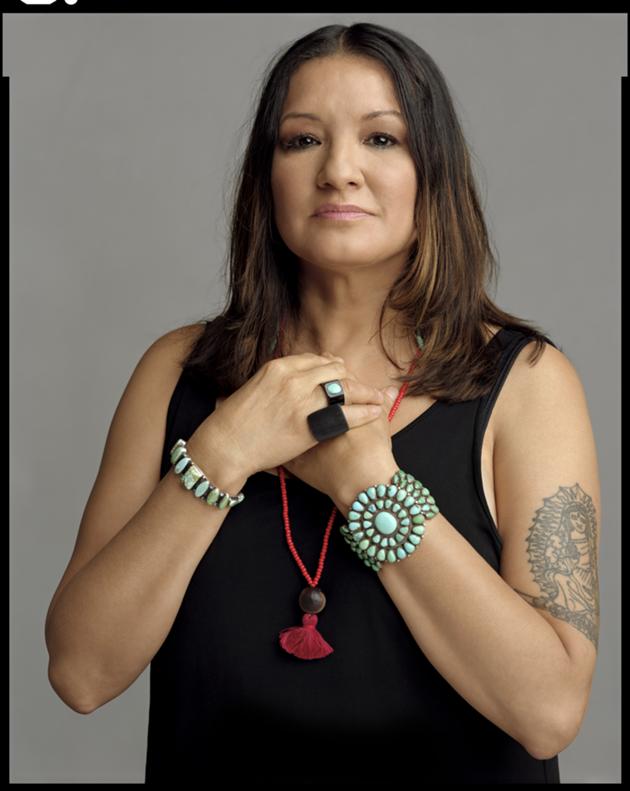
Sandra Cisneros announced this week that she plans to leave San Antonio to concentrate more on writing, according to this San Antonio Express-News article. She has put her home up for sale, and she is considering moving to New Mexico. The fate of the Macondo Foundation for writers remains unclear since Cisneros said she had difficulty balancing her writing with her charity.

 Writing contests: Pulitzer Prize winner Junot Diaz will judge stories (no longer than 1,000 words) based on their narrative voice for the Figment writing website. Deadline is Nov. 30. For details, click here.

Feb. 1 is the deadline to submit noir fiction for the Valley Artistic Outreach’s “Border Noir: Hard-Boiled Fiction from the Southwest,” an anthology of short stories to be edited by Machete co-screenwriter Alvaro Rodriguez. The book will come out in May. Stories can be sent to noir@valartout.org. For more information, click here.


Leave a comment

Filed under 2011 Books, Events, News

Book review: Sergio Troncoso’s “Crossing Borders: Personal Essays” and “From This Wicked Patch of Dust”

“Without words I can’t return and easily remember and appreciate my life behind me,” Mexican-American Sergio Troncoso writes. “I can’t see the road I traveled and how much I changed. Without words, I feel as I have never existed.”

In his two recently released books, Crossing Borders: Personal Essays (Arte Publico Press) and the novel From This Wicked Patch of Dust (University of Arizona Press), Troncoso tries to bring more meaning to his life and the world.

The title of Crossing Borders comes from the fact that Troncoso’s life bridges two cultures – as a former resident of the border town of El Paso; as a husband in an interfaith marriage and as a writer who belongs to an almost all-white literary group. In the 16 essays, Troncoso tackles issues such as the drug wars, immigration and literature. But Troncoso is at his best when he gets personal.

In an unusually honest essay, he talks about an intense argument with his father. He describes how much he loathes some of his father’s characteristics, yet still loves him. He also discusses his own role as a father to two boys. He can be temperamental toward them, too, when he succumbs to the pressures of life. But he is a devoted work-at-home father who admits his career takes second place to his children. “To make a good home for my children, I have sacrificed the only thing that matters more than my family: I have novels in my head which I may or may never get a chance to write,” he says.

After reading Borders, you can find similar elements of Troncoso’s life in From This Wicked Patch of Dust, which follows an immigrant family living in El Paso through five decades. One of the characters, like Troncoso, goes to college at Harvard and becomes a writer, marries a Jewish woman who works in the finance industry and raises two sons in New York City.

The stories are told in vignettes that capture a moment in time. The book can move slowly at times and Troncoso dwells on describing things that don’t need description. (You can skip a paragraph devoted to calculating the average depth of terrain). But Troncoso avoids clichés, with one character going through an interesting and surprising transformation in the book. Troncoso is an elegant writer whose work will make readers grateful that he writes his life down.

More about Sergio Troncoso:

• Troncoso discusses his writings on his blog, Chico Lingo. You can also find him on Facebook and YouTube.

2 Comments

Filed under 2011 Books, Book Reviews, Fiction, Non-Fiction

Book review: Dagoberto Gilb’s “Before the End, After the Beginning”

In his collection of short stories, Before the End, After the Beginning, Dagoberto Gilb uses ordinary men to talk about the big issues of our time.

Gilb tackles the economy, the immigration hysteria in Arizona and the painfulness of life in these ten short stories. Gilb knows the last subject all too well – in 2009, the Texan suffered a stroke. His best story, “please, thank you,” is about a man who is recovering from a stroke. The narrator, who does not use capitalization or most punctuation, describes how the nurses help him through his excruciating therapy.

“i do exercises on the padded table. stretches of the calves. then the quads. then i get on my stomach. i am supposed to lift my foot and calf ninety degrees, starting with the left. nothing, easy. when i try my right, its like nothing connects the two leg bones but kneecap. my calf flops on either side of my body. it doesnt hurt, theres no physical pain, but inside me, silently, it might be the worst indignity yet, so hard I cant cry or rage. its as though I have been slugged very hard and the pain hasn’t checked in.”

In his other stories, Gilb writes about ordinary guys caught up in complicated situations, sometimes through no fault of their own – a man looking for work who stays with his mysterious aunt; a family celebrating a child’s birthday amidst crime in the neighborhood; and a musician who doesn’t like the way a contractor treats the employees hired to paint his home. Gilb writes in simple prose that is as unpretentious as his characters. The reader gets caught up in these people’s lives, hoping that the character doesn’t suffer too much.

In a few of the stories, the main character seems to get in some sort of trouble with the police, making these stories seem a bit repetitive. It would have been nice to see a couple of more humorous stories like “Uncle Rock,” in which a boy goes to his first baseball game. But, overall, these stories are a pleasure to read.

@font-face { font-family: “Cambria”; }p.MsoNormal, li.MsoNormal, div.MsoNormal { margin: 0in 0in 0.0001pt; font-size: 12pt; font-family: “Times New Roman”; }div.Section1 { page: Section1; }

More about Dagoberto Gilb:

• Gilb will tour several Texas cities with Aztec Muse magazine editor Tony Diaz. They’ll be in San Antonio Wednesday; Dallas, Thursday-Friday; and Houston, Nov. 16-17.

• The San Antonio Express-News ran an interview with Gilb about the book.

1 Comment

Filed under 2011 Books, Book Reviews

Celebrating Dias de los Muertos in words

Oct. 31 marks the beginning of the three-day Dias de los Muertos, one of the Latino community’s most important holidays. Celebrants remember their loved ones who have passed away by creating altars and writing calaveras, or poems. The day has roots in the Aztec culture and now coincides with All Saints Day and All Souls Day Nov. 1 and Nov. 2. As this Associated Press article notes, the celebrations are gaining popularity across the country. Here’s some reading about the day:

• Azcentral.com has a great website about the holiday, including a history about the holiday and a list of books.

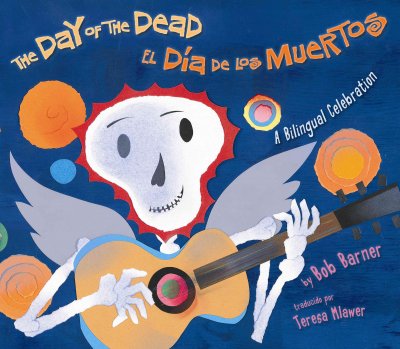
La Casa Azul Bookstore lists its favorite Dia de los Muertos books for children, including The Day of the Dead/El Dia de las Muertos by Bob Barner.

• Novelist Sandra Cisneros has created an altar for her mother that will be displayed at the National Hispanic Cultural Center in Albuquerque until March 2012, according to this article by the New Mexico Daily Lobo.

• The novel, Under the Volcano, by Malcolm Lowry, takes place on Dias de los Muertos. In the book, a British man self-destructs while in the Mexican city of Quauhnahuac. Time named it one of the 100 all-time greatest novels.

Leave a comment

Filed under Children's Books, Classic Books, Culture

Meet storyteller Joe Hayes, the man behind “La Llorona”

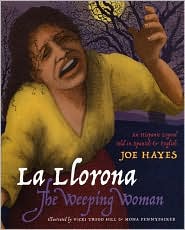
Halloween is approaching, and that means many storytellers will be weaving the famous Hispanic scary story of La Llorona, the weeping woman who drowned her children and looks for them along rivers and canals. The folktale, especially popular in Texas, has many versions. Storyteller Joe Hayes turned that story into a book, La Llorona/The Weeping Woman, in 1987, and it has gone on to sell more than 300,000 books for Cinco Puntos Press. Hayes grew up in Arizona, where he learned Spanish from his Mexican-American friends. Hayes has written more than three dozen children’s books that are written in English and Spanish.

Q: Why are people so intrigued by the tale of La Llorona?

There are really three aspects to the character of La Llorona. First, she’s a threatening character you have to look out for, especially if you’re a kid. This by far the best-known aspect. Many people know of her in this role, without knowing the tale behind it, or knowing only the detail that she drowned her children. And then there’s the legendary tale of her. It’s a legend because it’s widely accepted as factual. Finally, there are the many stories of personal experiences involving La Llorona. In my version in The Day It Snowed Tortillas (a collection of his short stories), I include all three aspects of her. And I think these three facets of La Llorona combine to make her so intriguing. Children are fascinated by a vague threat, and even more so if there’s a safety valve, a way to avoid the threat: Stay inside at night. The theme of a mother who kills her own children is widespread in folklore. It’s such a violation of the natural order, that people can’t quite get it out of their minds. And a character who is perpetually mourning and seeking forgiveness also has a strong hold on the imagination. Finally, so many people swear they’ve seen or heard La Llorona, that children can never quite declare that they don’t believe the story. There’s always that sense of “I don’t really think it’s true, but…but…”

Q: The story has many different versions. How did you adjust it to your book version?

I just started telling the story several decades ago, combining things I had heard as a kid with my own imagination. Over the years, the listeners helped me refine the story by the way they reacted to it. The printed version is somewhere between the way I started out telling and how I now tell it. I always tried not to glorify the violence that’s inherent in the tale, but refused to abandoned the essential fact that she drowned her children. I can’t stand some of the contemporary versions that turn La Llorona into a helpful character, or say that she didn’t actually drown the children. They rob the story of it’s mythic quality. The story, at least my story, of La Llorona is highly moralistic. It’s a teaching story.

Q: As an Anglo man, what has appealed to you about communicating through different cultures?

I have always believed that stories belong to those who honor and care for them. Years ago when I first started tellling stories, I knew that the story of La Llorona needed to be perpetuated. No other storytellers were telling it. So, without reasoning why, I just started telling the story. That’s changed now, of course. Many people tell it. I now realize that I’ve been able to make a greater contribution, both to Hispanic and non-Hispanic children, by not being Hispanic than I could ever have made were I Hispanic. It’s opened minds to the fact that words are for everyone, ideas are for everyone. The human family is one big round circle, not a lot of separate straight lines.

Leave a comment

Filed under Author Q&A, Children's Books, Classic Books

In the news

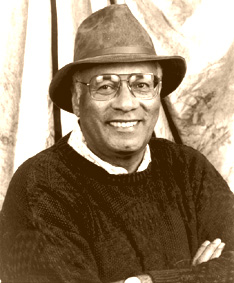
Puerto Rican/Cuban-American poet Piri Thomas (pictured at left) passed away last week. His book, Down These Mean Streets, described his life growing up in Spanish Harlem and became a staple in classrooms, according to this New York Times obituary.

• Here’s the round-up in book festivals this coming weekend:

Luis Alberto Urrea will speak at the Louisiana Book Festival Saturday in Baton Rouge.

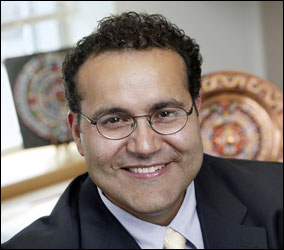
The Dallas International Book Festival, on Saturday, will feature novelist Esmeralda Santiago (pictured at right), children’s author Lucia Gonzalez, young adult author Ray Villareal and poet Joaquin Zihuatanejo.

The 31st Annual Book Fair of Santiago will run from Friday-Nov. 13 if you just so happen to be in Chile.

• Monday will be a big day for Arte Publico Press – it’s releasing several children’s and young adult books that day. The titles are: Don’t Call Me a Hero by Ray Villareal; The Lemon Tree Caper: A Mickey Rangel Mystery by René Saldana Jr.; ¡A Bailar! Let’s Dance! by Judith Ortiz Cofer and illustrated by Christina Ann Rodriguez; Clara and the Curandera by Monica Brown and illustrated by Thelma Muraida; and Adelita and the Veggie Cousins by Diane Gonzales Bertrand and illustrated by Christina Rodriguez.

Dagoberto Gilb, whose short story collection Before the End, After the Beginning comes out Tuesday, will tour several Texas cities with Aztec Muse magazine editor Tony Diaz. They’ll be in San Antonio Nov. 2; Dallas, Nov. 3-4; and Houston, Nov. 16-17. The Texas Observer covered his speech at last week’s Texas Book Festival, as well as Sergio Troncoso’s and Richard Yanez’s discussion about El Paso literature. (Scroll down the page for the articles.) Texas Monthly also excerpted a story in its latest issue. The Hispanic Reader will post a review of his book next week.

Leave a comment

Filed under 2011 Books, Author Profiles, Children's Books, Events, News, Young Adult Books

Book Review: Lyn Di Iorio’s “Outside the Bones”

If Kinsey Millhone or Stephanie Plum were Puerto Rican brujas, they’d be just like Fina, the lead character of Lyn Di Iorio’s first novel Outside the Bones (Arte Publico Press).

Like those smartass, crime-solving creations of Sue Grafton and Janet Evanovich, Fina uses her wits and attitude when she finds herself entangled in a murder mystery. But unlike many mysteries, Bones features mostly Hispanic characters and uses Afro-Carribean rituals as a mystery-solving device.

Fina is a New York City clerk who has a crush on her neighbor, musician Chico de León (another character with that great last name!). She puts a fufú, or curse, on him that goes badly – and leads to Fina to investigate Chico’s mysterious past in Puerto Rico, where his infant daughter and wife died while he was having an affair. Then his mistress and a woman claiming to be Chico’s daughter show up. So Fina enlists her “badass Godfather in the magic arts,” Tata Victor Tumba Fuego, to help conjure up spirits that may help solve the mystery. And then things start getting crazy.

The book gets its strength from Fina’s voice. If you don’t like attitude, bad grammar and foul language, you won’t like her. But then you would be deprived of such great lines as this, when Fina is taking a rooster to be sacrificed by Tata Victor: “Animal blood is the offering favored by the nkisis and nfuiris. And I understand the primitive principle behind it all. Blood is the most sacred form of energy, and when the spirits drink they become enlivened to help us in this world. But shit, we ain’t on the island no more, we don’t sacrifice in the mountains of Africa or Cuba; we do it in our apartments. Can’t we substitute and modernize a little with the other aspects of the religion? Streamline and make it more up to date?”

Even if you’re skeptical of the supernatural or the plot, Fina may make a believer out of you.

More about Lyn Di Iorio:

• Di Iorio talked to The Hispanic Reader about the inspiration for her book and how to encourage more people to get into Latino literature.

• Di Iorio will make several appearances for her book, including tonight at the Barnes and Noble at New York City’s Upper West Side.

• Di Iorio talked to the New York Daily News about Afro-Caribbean religions.

Leave a comment

Filed under 2011 Books, Fiction