Category Archives: Non-Fiction

Book review: Julia Alvarez’s “A Wedding in Haiti”

After the devastating 2010 earthquake in Haiti took more than 300,000 lives, many people felt compelled to help that country. Julia Alvarez wanted to go there.

She describes her experiences in her book, A Wedding in Haiti (Algonquin Books).

Her journey first began in 2009, when Alvarez and her husband, Bill, attended the wedding of Piti, a Haitian boy they had seen flying a kite near their coffee farm in her native Dominican Republic and they later hired to work on the farm.

But even before the earthquake, going to Haiti proves to be an ardurous journey, as Haiti’s infrastructure seems to be stuck in 1909.

A year later, Alvarez feels compelled to visit the country again after the earthquake.

“I didn’t have any answers for Haiti or fix-it advice or even a high road to take a moral stance for others to emulate. I just wanted to be with Haiti, and the line that kept echoing in my heart was the one from stations of the cross on Good Friday: Walk with me as I walk with you and never leave my side.

She makes the journey again  – compounded by bureaucracy and the devastation from the earthquake.

Alvarez doesn’t waste any words or get too fancy, making her writing so enjoyable to read. She is great at describing things – from a child’s schoolbook to a time when they had to drive through a river with the help of some Haitians, who then demand money. But the trips are worth the trouble as Alvarez describes the joy of the celebration – such as a scene in which the party-goers start to dance spontaneously.

Despite the devastation, she leaves the country with hope.

“So what is it that the eye is seeking and the heart is aching for? A flicker of wings, a thing that whispers hope. From a sidewalk wall hangs a red evening gown for sale. Incredible to think: there will be partying again! A boy in his school uniform walks by, holding the straps of his backpack. The very ordinariness of the moment seems a blessing.”

A Wedding in Haiti is a great book that gives readers a personal look at its people.

More about Julia Alvarez:

Julia Alvarez grew up in the Dominican Republic and came to the United States at age 10. She’s written numerous poems and books, including How the Garcia Girls Lost Their Accents and In the Time of Butterflies.

Source: I received a review copy from the publisher.
Leave a comment

Filed under 2012 Books, Book Reviews, Non-Fiction

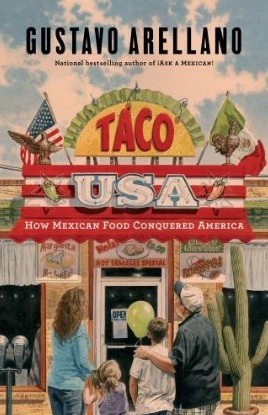
Book review: Gustavo Arellano’s “Taco USA: How Mexican Food Conquered America”

Gustavo Arellano’s Taco USA: How Mexican Food Conquered America (Scribner) is a literary feast.

Arellano covers the history of Mexican food, from its origins with the Aztecs to its present-day incarnations at Chipotle. In meticulous detail, Arellano writes about the selling of tamales on street corners, the emergence of the tortilla and salsa, and the creation of the margarita machine, among other topics.

Interestingly, some of the most prominent Mexican food – such as Taco Bell, Fritos and Paso picante sauce –was built up by Anglos. But all of the stories reveal great entrepreneurial spirit and ingenious inventions. (Sadly, his book went to press before the introduction of Doritos Locos Tacos.)

Arellano’s enthusiastic, descriptive and humorous writing makes this book so much fun to read. Check out this passage about a meal at Manuel’s El Tepeyac Café:

“There is a burrito sold in the Los Angeles neighborhood of Boyle Heights that’s beyond cosmic, that’s as close to touching God while eating Mexican food as finding Jesus on a tortilla. … Manuel’s Special: five pounds, beans and rice and guacamole and sour cream and your choice of meat – juicy nubs of grilled chicken, carne asada burned into succulent charcoal, or best with machaca, shredded beef that sticks between molars for hours afterward, heavily spiced and just grand, wrapped in a flour tortilla that, if laid flat, can serve as swaddling cloth for a puppy.”

A few quibbles: As a Texan, the book seemed a bit California-centric to me. How does the Rio Grande Valley get only one paragraph in a book about Mexican food? Although it doesn’t have the mass appeal of burritos and margaritas, I would have liked to read more about the history of pan dulce and menudo. I also would have liked to see some sociological and cultural analysis of the Americans’ seemingly contradictory anti-immigrant fervor and love for Mexican food.

The book left me hungry for that information, but it also made me hungry, literally. After reading the chapter on tortillas, I had to go to Chipotle (the closest available Mexican food place) for dinner.

Savor Taco USA. It’s as delightful as the meals Arellano describes.

More about Gustavo Arellano:

Gustavo Arellano, the editor of OC Weekly, is best known for his Ask a Mexican column. He also teaches at California State University, Fullerton.

Source: I purchased this book through Amazon.com.

1 Comment

Filed under 2012 Books, Book Reviews, Non-Fiction

Latinos and the Pulitzer Prize

Update: Quiara Alegría Hudes won the 2012 Pulitzer Prize in Drama for her play, Water by the Spoonful. I also included information on Sonia Nazario, which I forgot about when I first wrote this post until I saw her book in my co-worker’s office and thought, “I can’t believe I forgot Enrique’s Journey!”

The Pulitzer Prizes, which award the best in journalism and literary arts, will be announced on Monday. While the Nobel Prize in Literature is an international award that honors a lifetime achievement of work, the Pulitzers are an American award that recognizes the previous year’s work in a variety of categories. Here’s a look at some of the past Latino winners:

Fiction:

• Only two Hispanics have won this prize: Oscar Hijuelos for 1990’s The Mambo Kings Sing Songs of Love and Junot Díaz, right, for 2008’s The Brief Wondrous Life of Oscar Wao. Hopefully, the committee will consider Francisco Goldman’s Say Her Name, Justin Torres’s We the Animals and Hector Tobar’s The Barbarian Nurseries this year.

Drama:

• Nilo Cruz, left, is the lone Latino playwright to win this honor, for 2003’s Anna in the Tropics. Some writers have come close in recent years – Quiara Alegría Hudes was a finalist for 2007’s Elliot, A Soldier’s Fugue in 2007 and, with Lin-Manuel Miranda, 2009’s In the Heights, as was Kristoffer Diaz for 2010’s The Elaborate Entrance of Chad Deity.

Poetry:

• William Carlos Williams, right, whose mother was Puerto Rican, appears to be the lone poet with Latino roots to win in the category.

Sadly, no Latinos appear to have won in the autobiography, general non-fiction or history categories. Luis Alberto Urrea came close in 2005, when he was a finalist for general non-fiction category for The Devil’s Highway.

Journalism:

Latinos have won in various categories throughout the years – as part of teams covering the Los Angeles riots for The Los Angeles Times in 1992 and the Elian Gonzalez case for The Miami Herald in 2001. Here’s a look at some interesting winners of the past:

Ruben Vives, left, who came to the United States from Guatemala as an undocumented immigrant and worked his way to become a reporter for The Los Angeles Times, won the award last year for Public Service at age 32.

Liz Balmaseda of The Miami Herald was the first (and still only) Latino to win in the Commentary category in 1993.

SoniaNazarioSonia Nazario, who was raised in the United States and Argentina, wrote a series of articles for The Los Angeles Times about one boy’s travels from Honduras to the United States that won the 2003 Feature Writing prize and became the book Enrique’s Journey.

• Photographer José Galvez, right, was part of the first team of Latinos to win a Pulitzer when  The Los Angeles Times took the 1984 Public Service Prize for its series on Latino life in Southern California. His work can also be seen in Urrea’s book of poems Vatos and other books.

1 Comment

Filed under Awards, Features, Fiction, Non-Fiction, Poetry, Theater

In the news: April showers new books, awards and other news

New releases:

• Several Latino-oriented books are coming out in the next few weeks. Gustavo Arellano explores Americans’ fascination with Mexican food in Taco USA, which will be available this Tuesday. Read an excerpt here.

• Four interweaving stories, from South America to Boston, form the plot of Differential Equations by Julian Iragorri and Lou Aronica, out April 16.

Dagoberto Gilb’s “Uncle Rock” will be featured in the The PEN/O. Henry Prize Stories 2012 anthology, which will be published April 17.

Julia Alvarez’s new book, A Wedding in Haiti, out April 24, describes her experiences in that country before and after the 2010 earthquake. Also coming out that week is Roberto Bolaño’s The Secret of Evil, a collection of short stories, and Alisa Valdes’ The Temptation, the first in a supernatural trilogy.

Awards:

• Several Latinos were named as finalists in ForeWord Reviews’ Book of the Year contest, honoring books from independent publishers. Lyn DiIorio’s Outside the Bones made the Fiction-Literary list. Sergio Troncoso’s (left) Crossing Borders earned a spot in the Essays category and From This Wicked Patch of Dust made the Fiction-Multicultural list, as did Richard Yañez’s Cross Over Water and Rudolfo Anaya’s Randy Lopez Goes Home.

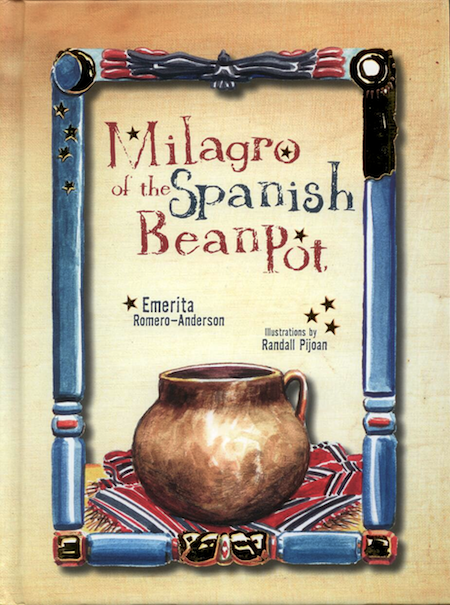
Troncoso’s From This Wicked Patch of Dust was also nominated in the Reading the West Book Awards in the Adult Fiction category. Emerita Romero-Anderson was nominated in the children’s category for Milagro of the Spanish Bean Pot.

Book festivals:

The Los Angeles Times Festival of Books, running April 20-21, will feature a plethora of authors, including Gustavo Arellano, Kami Garcia (left), José-Luis Orozco, Héctor Tobar and Luis Alberto Urrea. Rudolfo Anaya will be honored with a lifetime achievement award.

Writing workshops:

April 15 is the deadline to sign up for the National Latino Writers Conference May 16-19 at the National Hispanic Cultural Center in Albuquerque. Teachers include Jimmy Santiago Baca, Cristina García and Rigoberto González (right).

Body art by Mia Roman. Photographed by Johnny Ramos.

Other bits:

The New York Daily News profiled Aurora Anaya-Cerda’s (right) building of the Latino-oriented La Casa Azul bookstore in East Harlem, slated for a spring opening. Check out her progress on her Facebook page.

The Daily News also profiled poet Nuyorican poet Bonafide Rojas.

The Daily Show covered the Arizona ban on Latino-themed books and ethnic studies as only The Daily Show could.

Publishers Weekly had a nice write-up about Pat Mora’s Día: El día de los niños/El día de los libros, Children’s Day/Book.

Sergio Troncoso previews his panel, “Latino Literature, Then and Now,” to the Texas Library Association’s annual conference April 17-19 in Houston.

The Austin American-Statesman featured the Austin Latino New Play Festival.


2 Comments

Filed under 2012 Books, Awards, Children's Books, Events, Fiction, News, Non-Fiction, Poetry, Theater

Book review: Robert Andrew Powell’s “This Love is Not for Cowards”

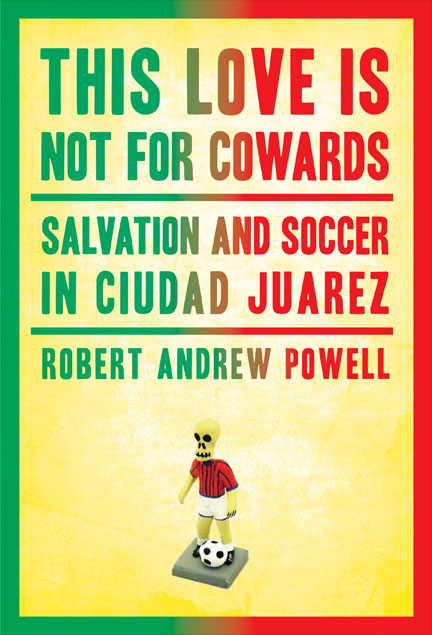
Robert Andrew Powell’s This Love is Not for Cowards: Salvation and Soccer in Ciudad Juárez revolves around two of Mexico’s most prominent subjects – its love for soccer and its dangerous drug trade.

Los Indios are the minor league soccer team near El Paso that scored a huge coup in 2009 – they have been accepted into the major leagues. This provides the people of Juárez a glimmer of hope as murders and violence become an everyday occurrence.

Powell describes the moment the team won the game that led to the promotion: “Players climbed onto the roof of their bus as young women danced in blue jeans and form-fitting red Indios jerseys tied at the waist. La gente, the people, proved to be bigger than the cartels. The city showed it was more than just violence.”

The book features several characters – Marco Vidal, the American who comes to Mexico so he can play the sport he loves; Francisco Ibarra, the team’s owner who lives in El Paso and has applied for American citizenship; and the cheekily named Ken-tokey, the student who belongs to the cheekily named El Kartel, the  booster club that supports and travels with the club.

Los Indios soon finds that playing in the major leagues isn’t so easy. But as Powell notes, “It’s been nice, for a while, to be in the fold, to be a city all of Mexico has to acknowledge is indeed in Mexico. However fleeing the coverage on ESPN Deportes, Juárez was still on ESPN Deportes.”

Powell is great at detailing the violence the surrounds the city and describing its land and its people. He also has an interesting chapter about the deaths of the women in Juárez that has drawn much media attention.

But the book’s strength is also its greatest weakness. Powell overdescribes things – even revealing the toppings of the pizza he eats at a restaurant. (Who cares?) The book starts to drag in the last 100 pages and, at times, I thought the story would have been better as a long article in Rolling Stone or The New Yorker than as a 256-page book.

Still, the book is an intriguing look at Juárez, providing a human face to a city that has been forsaken by so many.

More about Robert Andrew Powell:

Powell has written for The New York Times, Sports Illustrated and other magazines, as well the book We Own This Game. Read an excerpt from Love here.

Source: I purchased this book through Amazon.com.

Leave a comment

Filed under 2012 Books, Book Reviews, Non-Fiction

Book Review: Dr. Alfredo Quinones-Hinojosa’s “Becoming Dr. Q: My Journey from Migrant Farm Worker to Brain Surgeon”

As a young boy in Mexico, Dr. Alfredo Quiñones-Hinojosa admired Kalimán, a comic book character with superhero-like abilities.

Quiñones-Hinojosa has demonstrated the same abilities in his lifetime – jumping over a fence to get into the United States, working his way through college and medical school and becoming one of the top brain surgeons in the country – which he writes about in his autobiography Becoming Dr. Q: My Journey from Migrant Farm Worker to Brain Surgeon (University of California Press).

Quiñones-Hinojosa grew up in Mexicali, showing precocious leadership and academic skills at a young age. He came from a loving, but poor, family that endured the death of one child and worked in the fields of California. Believing he could make more money for his family, Quiñones-Hinojosa crossed the border illegally on his 19th birthday in 1987 – an event that makes for the book’s most riveting chapter.

The laws at the time made it possible for Quiñones-Hinojosa to obtain legal status and, eventually, his citizenship. His hard work and determination drove him to study at the University of California at Berkeley while working as a welder. Inspired by his curandero grandmother and his own desire to help others, he got into medicine, and he was accepted into Harvard Medical School.

“Two gears still drove me forward,” he writes. “One was for the dreamer and optimist in me who imagined, as I had from childhood, that I was destined to live forever. But the other was for the part of me that realized that life could be snatched away at any moment and felt I had to work hard at everything, as if each day were my last to live.”

Quiñones-Hinojosa goes through his residency while working on weekends and raising a young family – and he survives a few brushes with death. But the hard work pays off. He lands a job at Johns Hopkins Medical Center, one of the most prestigious medical institutions in the nation. He was featured on the ABC documentary Hopkins and PBS’s Nova.

Quiñones-Hinojosa, along with co-author Mim Eichler Rivas, writes in a matter-of-fact tone without sounding sorry for himself or arrogant. The fast-paced book is most intriguing when he writes about his early life. The last third of the book focuses on his medical cases, but it doesn’t get too technical and is easy to understand.

This book will appeal to almost everybody, but it should make its way to the hands of young Hispanics, who will hopefully make Dr. Q their own Kalimán.

More about Dr. Alfredo Quiñones-Hinojosa:

• The University of California Press posted an excerpt of the book here, which describes his baby sister’s death.

• Fox News Latino has an excellent article about Dr. Q. He also discussed his book on C-SPAN.

Leave a comment

Filed under 2011 Books, Book Reviews, Non-Fiction

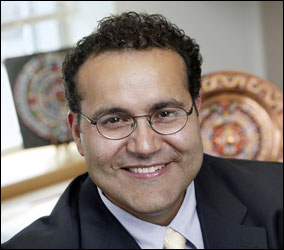
Book review: Sergio Troncoso’s “Crossing Borders: Personal Essays” and “From This Wicked Patch of Dust”

“Without words I can’t return and easily remember and appreciate my life behind me,” Mexican-American Sergio Troncoso writes. “I can’t see the road I traveled and how much I changed. Without words, I feel as I have never existed.”

In his two recently released books, Crossing Borders: Personal Essays (Arte Publico Press) and the novel From This Wicked Patch of Dust (University of Arizona Press), Troncoso tries to bring more meaning to his life and the world.

The title of Crossing Borders comes from the fact that Troncoso’s life bridges two cultures – as a former resident of the border town of El Paso; as a husband in an interfaith marriage and as a writer who belongs to an almost all-white literary group. In the 16 essays, Troncoso tackles issues such as the drug wars, immigration and literature. But Troncoso is at his best when he gets personal.

In an unusually honest essay, he talks about an intense argument with his father. He describes how much he loathes some of his father’s characteristics, yet still loves him. He also discusses his own role as a father to two boys. He can be temperamental toward them, too, when he succumbs to the pressures of life. But he is a devoted work-at-home father who admits his career takes second place to his children. “To make a good home for my children, I have sacrificed the only thing that matters more than my family: I have novels in my head which I may or may never get a chance to write,” he says.

After reading Borders, you can find similar elements of Troncoso’s life in From This Wicked Patch of Dust, which follows an immigrant family living in El Paso through five decades. One of the characters, like Troncoso, goes to college at Harvard and becomes a writer, marries a Jewish woman who works in the finance industry and raises two sons in New York City.

The stories are told in vignettes that capture a moment in time. The book can move slowly at times and Troncoso dwells on describing things that don’t need description. (You can skip a paragraph devoted to calculating the average depth of terrain). But Troncoso avoids clichés, with one character going through an interesting and surprising transformation in the book. Troncoso is an elegant writer whose work will make readers grateful that he writes his life down.

More about Sergio Troncoso:

• Troncoso discusses his writings on his blog, Chico Lingo. You can also find him on Facebook and YouTube.

2 Comments

Filed under 2011 Books, Book Reviews, Fiction, Non-Fiction

Meet journalist Edgar Sandoval

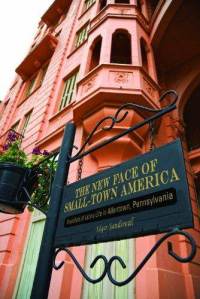
In his 1982 song “Allentown,” Billy Joel sang about a town that factory workers were leaving to find new opportunities. Since then, Latinos have immigrated to the Pennsylvania city and make up 25 percent of Allentown’s population. New York Daily News reporter Edgar Sandoval wrote about the change in the community in his 2010 book, The New Face of Small Town America.

Sandoval, who grew up in Zacatecas, Mexico, has worked for The (McAllen) Monitor; the South Florida Sun-Sentinel and The Allentown Morning Call before working as a general assignments reporter for the Daily News.

What inspired you to write the book The New Face of Small Town America?
I wrote most of the book without knowing it as a reporter for The Morning Call. I was hired to write a comprehensive look of the Latino community of Allentown, Pennsylvania, and its surrounding areas. Years later, while working as a reporter in South Florida, I met a literary agent visiting New York and she liked my stories, which were written in a narrative style. I tuned them into essays and wrote several new ones for the book. The result was The New Face of Small Town America published Penn State Press. It was all a pleasant surprise.

What kind of reaction have you gotten?
Most of the reaction has been positive, especially in Allentown, Pennsylvania. I have also been pleasantly surprised to see my book has been added to prestigious university libraries, such as Rutgers, and positive feedback from some newspapers and blogs. Of course, there were a few not so upbeat reviews. But, that’s the biz.

What Hispanic authors/books have inspired you?
Since I was a teen, I always admired many Latino writers like Victor Villasenor and Sandra Cisneros. Both are so inspirational and such genuine people. I never thought I would meet either in person. I remember when I met Villasenor during one of those NAHJ (National Association of Hispanic Journalists) conferences. He sensed my less that bright aura and made me scream, “I believe in myself,” in the middle of the crowd. I made sure to wave from afar from that day each time I run into him at such events. Then, through a friend of mine, I met Sandra Cisneros when I moved to New York a few years ago. I was a bit nervous walking up to the party where Sandra was a guest. Immediately, she made me feel at ease when she handed me a fan and said, “I like you. Fan me.” I have seen her a few times after that and it’s always hard to believe I’m talking to Sandra Cisneros!, and she’s so down to earth to me. She treats me like a regular person, unlike that waiter at Red Lobster.


Leave a comment

Filed under Author Q&A, Non-Fiction