Category Archives: Book Reviews

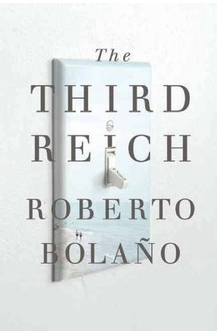
Book review: Roberto Bolaño’s “The Third Reich”

The Third Reich is a mystifying book.

Reich (Farrar Straus Giroux) was written by the late Roberto Bolaño, who was known for his critically acclaimed books such as The Savage Detectives and 2666. In this novel, German Udo Berger and his girlfriend, Ingeborg, visit a Spanish resort town that he used to visit as a child. While there, they meet a couple – Charley and Hanna – and spend a good deal of time with them.

But Udo is more interested in his war games that he’s set up in his hotel room. The game, called the Third Reich, is a simulation of World War II battles. Udo is Germany’s national champion at war games – a hobby even he finds a little odd when he goes to one of the conventions. “For my part, I came to the conclusion that eighty percent of the speakers needed psychiatric help,” he says.

But he has distractions from the game. Udo flirts with the hotel’s owner, Frau Else, who returns his affections despite having an ailing husband. Charley has an explosive, unpredictable personality that puts him in danger. Udo strikes up a friendship with a man named El Quemado, a muscular man with horrible burns all over his body – and soon rivals Udo at his own game.

While that seems like a lot of plot, it’s not. The book moves slowly. Udo has a passive personality that makes you wonder what he’s truly thinking, even though the book is told in first person. The book, translated by Natasha Wimmer, is easy to read, but readers may wish there was more action other than reports of his breakfast and technical descriptions of the game.

Fortunately, the conclusion of the book moves quickly and keeps you intrigued. The book has some deep observations, with World War II serving as a metaphor between Udo and El Quemado. And Bolaño, who wrote the book in 1989, is eerily prescient about how some of today’s gamers are isolated from society.

More about Roberto Bolaño:

Roberto Bolaño was born in 1953, grew up in Chile and Mexico City and died at age 50. The Third Reich was written in 1989 and found after his death. He won the National Book Critics Awards in 2009 for 2666.

Source: I received an advanced copy of the book from the publisher.

1 Comment

Filed under 2011 Books, Book Reviews, Fiction

Book Review: Rolando Hinojosa’s “Partners in Crime” and “A Voice of My Own”

Rolando Hinojosa may perhaps be one of the greatest storytellers from the Rio Grande Valley. Hinojosa, who grew up in Mercedes, Texas, a small town near the Mexican border, has written about the land’s quirks and contradictions in more than a dozen books. The Valley plays a big role in two books just released by Arte Publico Press, the detective story, Partners in Crime, and the collection A Voice of My Own: Essays and Stories.

Partners is part of the Klail City Death Trip series featuring Lieutenant Detective Rafe Buenrostro and taking place in Jones City, which appears to be modeled on Brownsville. In the novel, three men walk into a bar and start shooting up the place with their automatic rifles. The detectives must seek out the one clue about the murderers left by witnesses – a cream-colored Oldsmobile.

Partners was originally published in 1985 and the story takes place in 1972. It’s amusing to see how detectives worked without the Internet and cell phones, but the plot isn’t particularly captivating. The book’s strength comes from Hinojosa’s brisk writing. Like the detectives in the novel, he gives no bull but plenty of wit.

While Partners is an easy read, Hinojosa’s collections of short stories and essays are a little more frustrating. The 15 essays and four short stories – six of which are in Spanish – covers more than 25 years of writing about his life in the Valley and his thoughts on literature. Hinojosa, who is a creative writing professor at the University of Texas at Austin, can be wordy and unfocused in his pieces about literature. He uses the word “digression” often. He’s more interesting when he talks about his personal life, such as growing up in the Valley, describing his school days at the UT in the 1950s or showing how he wrote a poem.

The book ends with a few short stories. “Miami, Nice Climate” is a fast-paced  tale in the Rafe Buenrostro mode. “Es El Agua” is a beautiful and heartbreaking story about a migrant worker who recalls the travels in his life – from France, where he fought in the World War II and his brothers lost their lives, to the Midwest farms where he worked. But his home remains the Valley, the narrator says.

“It’s the water, the Rio Grande water,” the narrator says. “It claims you, you understand? It’s yours and you belong to it, too. No matter where we work, we always come back. To the border, to the Valley.”

 More about Rolando Hinojosa:

Hinojosa, who sometimes uses his mother’s name Smith, talked about his book of essays to the Austin Chronicle before his appearance at the Texas Book Festival earlier this year.

Source: I received advance copies of the books from Arte Público Press.

1 Comment

Filed under 2011 Books, Book Reviews, Classic Books

Book review: Luis Alberto Urrea’s “Queen of America”

Luis Alberto Urrea has done it again.

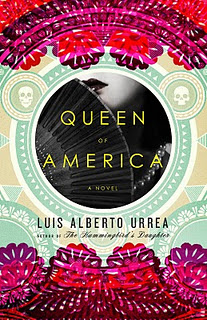
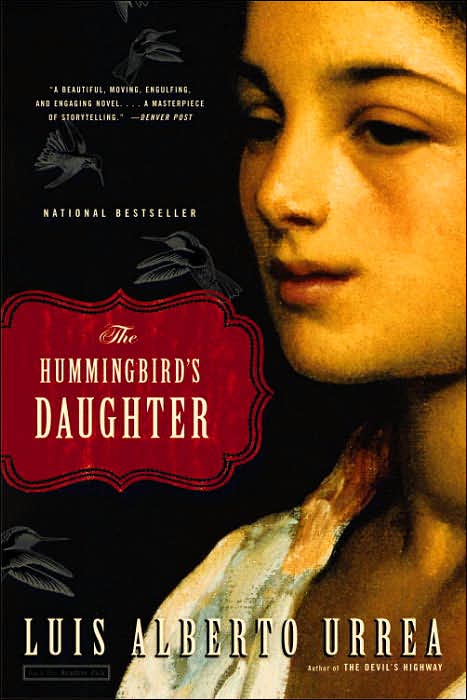
Urrea has released his new book, Queen of America (Little, Brown), the sequel to his brilliant 2005 novel, The Hummingbird’s Daughter. And while the tone of the books is different, the book is classic Urrea.

In Daughter, Teresita Urrea (the author’s great aunt) discovered her healing powers, earning her the name “Saint of Cabora” and leading an uprising of Mexican revolutionaries that prompted her and her father to escape to the north. America describes her journey to the United States, taking her from Arizona to El Paso to California to St. Louis to New York City. Teresita finds love along the way, but she also realizes the negative effects of being a celebrity, such as in this passage when she thinks about how her friends think of her now:

“They had once been her neighbors and friends, and then they become her followers. She felt a small chill of horror. Followers! It was terrible to have followers. But it was more terrible that part of her liked it.

Of course, she could not control her fanatics, only herself. Balance, again. When she had followers, she was watched over by the government and the newspapers. People copied her words in notebooks. She caught herself wondering what she had said and worrying all night if this time her careless utterances would lead to someone’s death or some outbreak of madness she could not have foreseen. Sometimes you just want to speak without measuring your words! Sometimes you want to laugh and sing! Sometimes you just want to ride your horse!”

That passage shows why Urrea is such a great writer. He’s just so much fun to read. Besides his beautiful descriptions and witty dialogue, he also creates some memorable characters, such as Teresita’s father, Don Tómas. His selfishness, arrogance and lack of self-awareness brings some of the biggest laughs in the book.

Check out this dialogue between Teresita and Tómas:

“‘I never said I was a saint … I am a prophet.’

‘Oh God, no,’ he said. ‘What you are is nineteen years old.’”

Or read this conversation between Tómas and a businessman seeking to exploit Teresita:

“‘You will provide for her with your Consortium profits. You incorporate. Partners. But structured so that she can honestly say she took nothing. It will honor her, shall we say, religious beliefs.’

‘I love America,’ Tómas said.”

But Tómas is absent from the last half of the book as Queen focuses mostly on Teresita’s journey. And then the book becomes somber, as Teresita realizes that not everyone has the best intentions for her and she yearns to return to her homeland. The reader becomes a bit melancholy, too, as another great book comes to an end.

More about Luis Alberto Urrea:

Urrea spent 26 years researching and writing The Hummingbird’s Daughter and Queen of America, and he did it while writing other books, such as Into the Beautiful North and the non-fiction The Devil’s Highway.

Urrea has a great website, which includes tour dates and a blog. And follow Urrea on his Facebook and Twitter feeds. He’s a lot of fun on there, too.

1 Comment

Filed under 2011 Books, Book Reviews, Fiction

Book Review: Dr. Alfredo Quinones-Hinojosa’s “Becoming Dr. Q: My Journey from Migrant Farm Worker to Brain Surgeon”

As a young boy in Mexico, Dr. Alfredo Quiñones-Hinojosa admired Kalimán, a comic book character with superhero-like abilities.

Quiñones-Hinojosa has demonstrated the same abilities in his lifetime – jumping over a fence to get into the United States, working his way through college and medical school and becoming one of the top brain surgeons in the country – which he writes about in his autobiography Becoming Dr. Q: My Journey from Migrant Farm Worker to Brain Surgeon (University of California Press).

Quiñones-Hinojosa grew up in Mexicali, showing precocious leadership and academic skills at a young age. He came from a loving, but poor, family that endured the death of one child and worked in the fields of California. Believing he could make more money for his family, Quiñones-Hinojosa crossed the border illegally on his 19th birthday in 1987 – an event that makes for the book’s most riveting chapter.

The laws at the time made it possible for Quiñones-Hinojosa to obtain legal status and, eventually, his citizenship. His hard work and determination drove him to study at the University of California at Berkeley while working as a welder. Inspired by his curandero grandmother and his own desire to help others, he got into medicine, and he was accepted into Harvard Medical School.

“Two gears still drove me forward,” he writes. “One was for the dreamer and optimist in me who imagined, as I had from childhood, that I was destined to live forever. But the other was for the part of me that realized that life could be snatched away at any moment and felt I had to work hard at everything, as if each day were my last to live.”

Quiñones-Hinojosa goes through his residency while working on weekends and raising a young family – and he survives a few brushes with death. But the hard work pays off. He lands a job at Johns Hopkins Medical Center, one of the most prestigious medical institutions in the nation. He was featured on the ABC documentary Hopkins and PBS’s Nova.

Quiñones-Hinojosa, along with co-author Mim Eichler Rivas, writes in a matter-of-fact tone without sounding sorry for himself or arrogant. The fast-paced book is most intriguing when he writes about his early life. The last third of the book focuses on his medical cases, but it doesn’t get too technical and is easy to understand.

This book will appeal to almost everybody, but it should make its way to the hands of young Hispanics, who will hopefully make Dr. Q their own Kalimán.

More about Dr. Alfredo Quiñones-Hinojosa:

• The University of California Press posted an excerpt of the book here, which describes his baby sister’s death.

• Fox News Latino has an excellent article about Dr. Q. He also discussed his book on C-SPAN.

Leave a comment

Filed under 2011 Books, Book Reviews, Non-Fiction

Book review: José Saramago’s “Cain”

Nobel Prize winner José Saramago is known for his dark words such as Blindness. Who knew he was such a comedian?

The late Portuguese’s last novel, Cain, released last month, tells some of the stories of the Bible from the perspective of Adam and Eve’s son, Cain, who killed his brother, Abel, out of jealousy. After the murder, Cain witnesses historical events from the Bible – the destruction of Sodom and Gomorrah, the creation of the golden calf and the construction of Noah’s Ark.

Through it all, Saramago offers some wry observations – such as when Eve complains about having diarrhea. “What’s diarrhea, asked the angel, Another word for it is the runs, the vocabulary the lord taught us has a word for everything, having diarrhea or the runs, if you prefer that term, means that you can’t retain the shit you have inside you.”

Or this, when Abraham is asked to sacrifice his son, Isaac: “The logical, natural and simply human response would have been for abraham to tell the lord to piss off, but that isn’t what happened.”

(By the way, Saramago doesn’t capitalize names or use quote marks in the book.)

Of course, Saramago, who was known for his atheist views, is mocking the Bible. Cain frequently questions the Lord’s motives in killing thousands of innocent lives during the destruction of Sodom and Gomorrah and the Golden Calf. Fans of Kurt Vonnegut and Christopher Hitches will love this stuff.

Saramago writes in never-ending sentences and never-ending paragraphs that may have some readers rereading passages. But, at 159 pages, Cain is a quick read and, considering the complexity of his other books, this may be a good starting point for his work.

More about José Saramago:

Saramago won the Nobel Prize for Literature in 1998. The Nobel’s website includes this biography.

Margaret Jull Costa, who translated Cain and Paulo Coelho’s recent book Aleph, wrote about him in this article for Granta magazine.

1 Comment

Filed under 2011 Books, Author Profiles, Book Reviews

Book review: Sergio Troncoso’s “Crossing Borders: Personal Essays” and “From This Wicked Patch of Dust”

“Without words I can’t return and easily remember and appreciate my life behind me,” Mexican-American Sergio Troncoso writes. “I can’t see the road I traveled and how much I changed. Without words, I feel as I have never existed.”

In his two recently released books, Crossing Borders: Personal Essays (Arte Publico Press) and the novel From This Wicked Patch of Dust (University of Arizona Press), Troncoso tries to bring more meaning to his life and the world.

The title of Crossing Borders comes from the fact that Troncoso’s life bridges two cultures – as a former resident of the border town of El Paso; as a husband in an interfaith marriage and as a writer who belongs to an almost all-white literary group. In the 16 essays, Troncoso tackles issues such as the drug wars, immigration and literature. But Troncoso is at his best when he gets personal.

In an unusually honest essay, he talks about an intense argument with his father. He describes how much he loathes some of his father’s characteristics, yet still loves him. He also discusses his own role as a father to two boys. He can be temperamental toward them, too, when he succumbs to the pressures of life. But he is a devoted work-at-home father who admits his career takes second place to his children. “To make a good home for my children, I have sacrificed the only thing that matters more than my family: I have novels in my head which I may or may never get a chance to write,” he says.

After reading Borders, you can find similar elements of Troncoso’s life in From This Wicked Patch of Dust, which follows an immigrant family living in El Paso through five decades. One of the characters, like Troncoso, goes to college at Harvard and becomes a writer, marries a Jewish woman who works in the finance industry and raises two sons in New York City.

The stories are told in vignettes that capture a moment in time. The book can move slowly at times and Troncoso dwells on describing things that don’t need description. (You can skip a paragraph devoted to calculating the average depth of terrain). But Troncoso avoids clichés, with one character going through an interesting and surprising transformation in the book. Troncoso is an elegant writer whose work will make readers grateful that he writes his life down.

More about Sergio Troncoso:

• Troncoso discusses his writings on his blog, Chico Lingo. You can also find him on Facebook and YouTube.

2 Comments

Filed under 2011 Books, Book Reviews, Fiction, Non-Fiction

Book review: Dagoberto Gilb’s “Before the End, After the Beginning”

In his collection of short stories, Before the End, After the Beginning, Dagoberto Gilb uses ordinary men to talk about the big issues of our time.

Gilb tackles the economy, the immigration hysteria in Arizona and the painfulness of life in these ten short stories. Gilb knows the last subject all too well – in 2009, the Texan suffered a stroke. His best story, “please, thank you,” is about a man who is recovering from a stroke. The narrator, who does not use capitalization or most punctuation, describes how the nurses help him through his excruciating therapy.

“i do exercises on the padded table. stretches of the calves. then the quads. then i get on my stomach. i am supposed to lift my foot and calf ninety degrees, starting with the left. nothing, easy. when i try my right, its like nothing connects the two leg bones but kneecap. my calf flops on either side of my body. it doesnt hurt, theres no physical pain, but inside me, silently, it might be the worst indignity yet, so hard I cant cry or rage. its as though I have been slugged very hard and the pain hasn’t checked in.”

In his other stories, Gilb writes about ordinary guys caught up in complicated situations, sometimes through no fault of their own – a man looking for work who stays with his mysterious aunt; a family celebrating a child’s birthday amidst crime in the neighborhood; and a musician who doesn’t like the way a contractor treats the employees hired to paint his home. Gilb writes in simple prose that is as unpretentious as his characters. The reader gets caught up in these people’s lives, hoping that the character doesn’t suffer too much.

In a few of the stories, the main character seems to get in some sort of trouble with the police, making these stories seem a bit repetitive. It would have been nice to see a couple of more humorous stories like “Uncle Rock,” in which a boy goes to his first baseball game. But, overall, these stories are a pleasure to read.

@font-face { font-family: “Cambria”; }p.MsoNormal, li.MsoNormal, div.MsoNormal { margin: 0in 0in 0.0001pt; font-size: 12pt; font-family: “Times New Roman”; }div.Section1 { page: Section1; }

More about Dagoberto Gilb:

• Gilb will tour several Texas cities with Aztec Muse magazine editor Tony Diaz. They’ll be in San Antonio Wednesday; Dallas, Thursday-Friday; and Houston, Nov. 16-17.

• The San Antonio Express-News ran an interview with Gilb about the book.

1 Comment

Filed under 2011 Books, Book Reviews

Classic Book Review: “The Hummingbird’s Daughter”

In preparation for Luis Alberto Urrea’s upcoming Queen of America, I wanted to read its predecessor, The Hummingbird’s Daughter, which was published in 2005. I was intimidated by the 500-page book and its serious description on the book cover, but I shouldn’t have been. Every page was a joy to read.

Daughter, which takes place in the 1800s in a small Mexican village, centers on Teresita, who was born out of wedlock and is abandoned by her mother, Cayetana, but she is later groomed by her father, the womanizing ranch owner Tomás Urrea.

As the story progresses, Teresita discovers has powers of healing. But rebels are stirring up a revolution in Mexico while hundreds of villagers are flocking to Teresita so she will cure them. Soon, the two forces collide.

Besides the tightly paced plot, Urrea imbues Daughter with rich language. One character “had the face of an Aztec carving.” In another passage, Urrea compares the villagers’ complexion to a character’s drink: “Every Mexican was a diluted Indian, invaded by milk like the coffee in Cayetana’s cup.”

Urrea knows how to build tension in a scene – and put in some comic relief, too. Sometimes, he accomplishes it all in one scene, such as when Tomás’s wife, Loreto, confronts him about an affair as several friends, including two named Aguirre and Huila, watch:

“Loreto slapped Tomás.

He spluttered an obscenity.

She slapped his other check.

He raised his hand.

Aguirre rose.

Huila, watching, clenched her hands – this was even better than she’d hoped!”

Here’s another great line: “If you are too blind to see God in Goddamned taco, then you are truly blind.”

And another: “A Mennonite missionary had moved through the ranchos assuring them that Jesus Christ would return to earth by 1880 – maybe He was early.”

Daughter was a fantastic read. I can’t wait for Queen of America.

More about Luis Alberto Urrea:

• Urrea is just as witty in his Twitter and Facebook feeds. His website features a blog, readings from Queen of America and upcoming appearances. Queen of America will be released in December.

Leave a comment

Filed under Book Reviews, Classic Books, Fiction

Book review: Paulo Coehlo’s “Aleph”

Paulo Coelho’s Aleph is not just a novel – but also a guidebook on how to live life in the present.

Coelho is the best-selling, beloved Brazilian novelist of The Alchemist and, like that book, Aleph is about a spiritual journey. The main character – a best-selling, beloved Brazilian novelist – is going through a mid-life crisis when he spontaneously decides to travel through Russia on the Trans-Siberian Railway to meet his fans.

While on the trip, a 21-year-old woman named Hilal insists on traveling with him. Although he is turned off by her aggressive behavior, he finds peace when he experiences an “aleph” – “the point at which everything is in the same place at the same time” – and sees scenes from his past lives.

They soon realize they’ve experienced the same thing. “The great Aleph,” the narrator tells Hilal, “occurs when two or more people with a very strong affinity happen to find themselves in the same Aleph.”

Now they must figure out their shared connection. They find the mystery frustrating, since Hilal is very stubborn and Paulo is very married.

The book, translated by Margaret Jull Costa, is a quick read that has an intriguing twist about Paulo’s actions to Hilal in a past life. It is also filled with life-affirming metaphors, such as the mode of transportation: “Life is the train, not the station.”

Whether you love the book depends on your view on life. Some readers, such as those who follow Eckhart Tolle, will enjoy the passages in the book about living in the present and forgiving yourself and others. But other readers may find the book – with its touchy-feely New Age philosophies and talk of reincarnation – not for them.

More about Paulo Coelho:

• Biography.com has an interesting article on Coelho.

• Coelho discussed his secrets to reaching fans on social media to The Wall Street Journal.

Leave a comment

Filed under 2011 Books, Book Reviews, Fiction

Book review: Héctor Tobar’s “The Barbarian Nurseries”

Héctor Tobar’s novel, The Barbarian Nurseries (Farrar, Straus and Giroux) covers everything from the immigration debate to suburban angst – and he does it brilliantly.

His novel centers on Scott and Maureen Torres-Thompson, an Orange County couple who have it all – a beautiful home with an ocean view, two bright sons who go to private school and loads of debt. They’ve laid off their gardener and nanny, but have retained their housekeeper, Araceli, an undocumented immigrant from Mexico City who works for them for $250 a week and housing.

After the couple has an intense argument, Araceli is left alone with the two boys, Brandon, 11, and Keenan, 8. Through a series of circumstances, she finds herself lost in the labyrinth that is Los Angeles – and facing serious consequences that she barely understands.

Scott and Maureen also question their lifestyles. As Maureen, a stay-at-home mom, says of Araceli, “I have allowed this person to live in my home for four years without once having a substantial conversation about where she is from, about her brothers and sisters, or about how she got here.”

The book starts off slowly, but once it gets going, you don’t want to stop reading. Tobar, a Pulitzer-prize winning reporter for The Los Angeles Times, keeps the plot tight while zinging ambitious lawyers and politicians, angry white conservatives, do-gooder liberals, and the sensational media along the way. He writes the female characters well, making Araceli a complex character with ambitions beyond cleaning homes. Tobar even nails a romantic scene. Can we give this man another Pulitzer Prize?

More about Héctor Tobar:

• Tobar, the son of Guatemalan immigrants, writes a weekly column for The Los Angeles Times.

• Tobar is scheduled to make about a dozen appearances across the country in support of his book.

In this NPR profile, Tobar discusses the inspiration for the book.

Leave a comment

Filed under 2011 Books, Book Reviews, Fiction