Category Archives: Book Reviews

Classic book review: Lorraine López’s “The Realm of Hungry Spirits”

Marina Lucero is having a stressful week.

In the first 50 pages of Lorraine López’s 2011 novel The Realm of Hungry Spirits, Marina has to comfort friends who lost their newborn baby; helps a neighbor being abused by her husband; puts up with two young adults crashing in her home; and ponders an offer to have her home cleansed in a Santeria practice.

“It’s like you’re host to a whole realm of hungry spirits,” one character tells her.

But Marina, a divorced teacher in the Los Angeles area, turns to Buddhism to practice compassion for others. It’s something she’s needed for a long time.

“(I wonder) why my life has to be this way: long stretches of mundane nothingness interrupted by a succession of tortuous days,” she says.

This book has plenty of drama, including one stunning twist at the end, but Hungry Spirits is actually a funny, fast-paced book that reminded me of Denise Chavez’s Loving Pedro Infante.

Take this line when an old man looks up her skirt.

“My palm tingles, so strong is the impulse to slap the lewd grin from his ancient face, but striking an old man is surely no way to attain Buddhahood.”

Or this:

“A small crucifix dangles from a slender gold chain around her neck, and I marvel anew at the way Christians blithely display artifacts commemorating the sadistic torture and murder of their founding leader. I know, I mean Christ is supposed to have died for their sins and all that, but still, adorning oneself with his crucified body, doesn’t that strike anyone but me as weird?”

My one complaint is that the book is stuffed with so many characters that I should have created a chart to keep up with everyone.

But López does a great job of showing the importance – and annoyance – of family in Latino life and, in a nice touch, she also mentions a few Hispanic authors.

A special nod should go to the book’s publisher, Grand Central Publishing, which has published several terrific novels by Latinas in the past few years – including Julia Amante’s Say You’ll Be Mine; Leila Cobo’s The Second Time We Met; and Gwendolyn Zepeda’s recently released Better With You Here.

Like Hungry Spirits, these are easy to read books that women will relate to and enjoy.

More about Lorraine López:

Lorraine López is the author of the short story collections Soy la Avon Lady and Other Stories and Homicide Survivor Picnic and Other Stories, the young adult novel Call Me Henri and the novel The Gifted Gabaldón Sisters. She teaches at Vanderbilt University in Nashville.

Source: I purchased this book through Amazon.com.

Note: This book is part of the series of classic books by Latina authors. Next up: Pamela Muñoz Ryan’s Esperanza Rising.


Leave a comment

Filed under 2011 Books, Book Reviews, Fiction

Book review: Gwendolyn Zepeda’s “Better with You Here”

In Gwendolyn Zepeda’s Better with You Here (Grand Central Publishing), single mother Natasha Davila can’t catch a break.

In the opening chapter, she’s competing with her ex-husband’s new girlfriend and dealing her son’s damp underwear.

“Fifty percent of my job as a mother is cleaning up bodily fluids… And then the other 50 percent is worrying,” she says.

Just when Natasha is getting some good luck – finding a decent babysitter and making friends with two other women in her Dallas apartment complex – her ex-husband demands full custody of their children, Alex and Lucia.

Better is a great read thanks to a fast-paced plot with a few interesting twists. But it’s strength lies in Natasha’s voice. She speaks matter-of-factly when she’s recounting her woes, not feeling sorry for herself. When she’s angry, she’s on fire and Zepeda’s words just flow.

“… I picked the wrong man to marry, which is what brought me to this point tobegin with.

What was the last thing I did right? If I had a time machine, how far back would I have to go to undo all the mistakes I’ve made?

This is stupid. Stop thinking this way. Why would I go back and undo anything? I wouldn’t want to live my life again without having Alex and Lucia, would I? No. And there’s no such thing as a time machine, so shut up. Get back to reality. Plan your next move.”

Zepeda is also terrific at describing the little things – such as the way the women struggle to make ends meet. In one scene, Natasha reveals her biggest loss since her divorce.

“That’s what I miss most about being married – my washer and dryer.”

Two other narrators are featured in the book – her 8-year-old son Alex and her friend Sara. Sara’s voice shows her smart-ass attitude (“I can’t stand church. It’s too damn boring.”), but a few of her lines are confusing and annoying.

Still, that’s one of the few weaknesses in this compelling book. Better with You Here makes a great summer read.

More about Gwendolyn Zepeda:

Texas native Gwendolyn Zepeda is the author of Houston, We Have A Problema and Lone Star Legend, as well as the children’s books Growing Up with Tamales and Sunflowers.

Source: I received a review copy from the publisher.

Leave a comment

Filed under 2012 Books, Book Reviews, Fiction

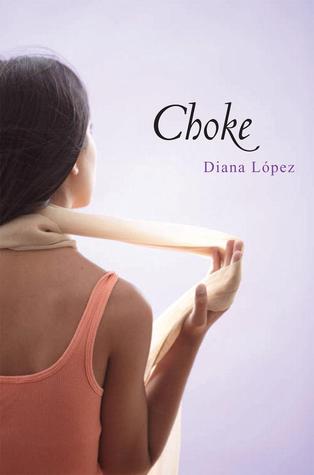
Book review: Diana López’s “Choke”

Windy Soto is an average eighth grade student when she gets to hang out with the popular crowd for the first time in her life. It’s an opportunity that puts her life in danger.

In Diana López’s young adult novel Choke (Scholastic Press), Windy becomes intrigued by Nina Díaz, the new girl who stands up to the cool kids – and acts nice to Windy. Windy even neglects her dorky best friend, Elena. But Windy soon learns that Nina has her friends play “the choking game,” in which teens choke each other until they pass out.

Choke is an easy-to-read book, although the exposition takes a little too long. López, a former middle school teacher who wrote the book after seeing her own students play the game, captures teenage angst well, especially in the opening paragraphs of the book:

“My middle school has the ‘in-crowd,’ the ‘out-crowd, and the ‘GP.’ ‘GP’ stands for ‘general public,’ just like the movie rating. The in-crowd works hard to stay out of the GP, while the out-crowd works hard to get in. I’m definitely GP, general public in every way. … Sometimes I like being GP because not one expects me to run for student council or compete in the academic decathlon. Being GP means being invisible … Being invisible has its benefits, but it can be boring, too. … I want to be part of the in-crowd. I want the keys to their golden lockers, the ones that decorated with streamers and ribbons on Spirit Day. The ones with mirrors on the inside door, mirrors reflecting beautiful faces and surrounded by pictures of beautiful BFFs.”

The novel, which takes place in San Antonio, features mostly Hispanic characters and the occasional nod to Latino life – such as barbacoa meals – but it should appeal to all middle school students. This book could even save a few lives.

More about Diana López:

Diana López, who grew up in Corpus Christi, Texas, is the editor of the Huizache literary magazine and teaches literature and creative writing at the University of Houston at Victoria. She also wrote Sofia’s Saints and the young adult novel Confetti Girl

Source: I received a review copy of the book from the publisher.

Leave a comment

Filed under 2012 Books, Book Reviews, Young Adult Books

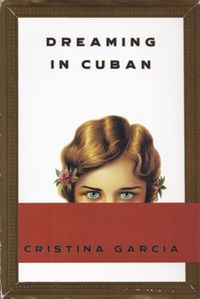
Classic book review: Cristina García’s “Dreaming in Cuban”

Cristina Garcia’s 1993 novel Dreaming in Cuban shows life under Fidel Castro’s rule from the point of view of three generations of strong women.

The del Pino family is led by Celia, who spends her last days patrolling the Cuban seas from any attacks from foreign invaders while memories of her past invade her mind. Celia has two daughters – Felicia, who faces abuse by her husband, and Lourdes, who goes to New York City and runs a successful business. Lourdes has a daughter, Pilar, who as a child of the late 1970s, rebels against her mother and yearns to go back to Cuba.

Occasionally, a male voice – such as Ivanito, Felicia’s son, gets a few pages – but this story is clearly about the women.

Garcia writes wonderfully descriptive passages, including the beginning of the book when Celia is out by the sea and sees her husband: “His blue eyes are like lasers in the night. The beams bounce off his fingernails, five hard blue shields. They scan the beach, illuminating shells and sleeping gulls, then focus on her.” The book also has some great observations about life. “Everything is mixed up, as if parts of me are turning in different directions at once,” Ivanito says.

But the book is challenging to read. The story is told in fragments, jumping back and forth in time and from narrator to narrator and from first person to third person. The mood of the book is mostly heavy – especially Felicia’s passages, so it’s a relief when Pilar comes along in with her wry observations or when Celia judges family disputes as head of the People’s Court. But, much of the time, the book drags because it doesn’t have a linear storyline that keeps the reader riveted.

If you like books with great description, Dreaming in Cuban is something you might enjoy. But it may be a frustrating read for those who prefer a strong plot.

More about Cristina Garcia:

Cristina García has written numerous novels, including The Lady Matador’s Hotel and, most recently, the young adult novel, Dreams of Significant Girls. Like the character Pilar, she grew up in New York City and attended Barnard College.

Source: I checked this book out of the library.

Note: This book is part of the series of classic books by Latina authors. Next up: Lorraine López’s The Realm of Hungry Spirits.

1 Comment

Filed under Book Reviews, Classic Books, Fiction

Book review: Robert Ampuero’s “The Neruda Case”

Roberto Ampuero’s The Neruda Case (Riverhead Books) is a fascinating book that combines a missing persons case, one of Chile’s most historic events and the life story of Latin America’s greatest poet.

Detective Cayetano Brulé is living in Valparaíso, Chile, in 1973 when he is asked by poet Pablo Neruda to find an old lover. The search takes Brulé to Mexico, Cuba and Germany – and he discovers some things about Neruda that lessens his deep admiration for the 70-year-old.

While the search is going on, Neruda is dying of cancer and remembering his past lovers from his life, including his time as a diplomat. He is feeling regret, including the abandonment of his wife when their child was born with a birth defect. Meanwhile, the country of Chile is under tumult as the government of Socialist President Salvador Allende – Neruda’s friend – is under siege from General Pinochet.

Ampuero, who used to live near Neruda when he was a child, kept most of the historical details but fictionalized the missing lover case. Ampuero writes at a fast pace so that even his descriptive passages don’t slow down the story. The book only becomes more intense as General Pinochet is preparing a coup. But, like Brulé, readers may have a different impression of Neruda as they read the book. He comes across as a selfish cad – or maybe just more human than his romantic poems.

The Neruda Case, which was translated by Perla author Carolina DeRobertis, is a great book that is not to be missed.

More about Roberto Ampeuro: Ampuero has written a dozen novels in Spanish, with The Neruda Case being his first published in English. He serves as Chile’s ambassador to Mexico and is a professor of creative writing at the University of Iowa. He wrote about his memories of the poet in this essay published in The Daily Beast/Newsweek.

Source: I received a review copy from the publisher.

Leave a comment

Filed under 2012 Books, Book Reviews, Fiction

Classic book review: Laura Esquivel’s “Like Water for Chocolate”

In the early 1990s, Like Water for Chocolate: A Novel in Monthly Installments with Recipes, Romances, and Home Remedies by Laura Esquivel was one of the most popular books in the world, thanks to a well-made movie and an intriguing love story. Its popularity was well-earned.

The main character, Tita, has been told that she must take care of her mother Mama Elena in her old age – denying her a chance to be with Pedro, who has declared his love for her. He agrees to marry her older sister, Rosaura, so he can be closer to her.

While Pedro and Rosaura are raising a family and the revolution rages in Mexico, Tita is running the family ranch. The events of her life push her to feel “‘like water for chocolate’ – she was on the verge for boiling over.’”

In fact, her volatile emotions are felt in the meals she cooks for her family – causing those who eat her food to feel the same emotions she does. (The recipes are printed at the beginning of each of the 12 chapters, although they seem too elaborate to cook.)

Although it’s story about love, Like Water is also interesting when depicting family dynamics and early feminism. Mama Elena is portrayed as a domineering woman who rules the household, and Tita questions why the youngest daughter has to take care of the mother. Here’s one great passage that describes her life:

“At her mother’s, what she had to do with her hands was strictly determined, no questions asked. She had to get up, get dressed, get the fire going in the stove, fix breakfast, feed the animals, wash the dishes, make the beds, fix lunch, wash the dishes, iron the clothes, fix dinner, wash the dishes, day after day, year after year. Without pausing for a moment, without wondering if this is what she wanted.”

I’m not always a big fan of magic realism, but it works well in this novel because, oddly, it seems natural. This is a great book that – thanks to its creativity and strong heroine – is as satisfying as one of its meals.

More about Laura Esquivel: Laura Esquivel, who lives in Mexico City, is a former teacher who also has written the books The Law of Love, Between Two Fires: Intimate Writings on Life, Love, Food, and Flavor and Malinche. The book was translated by Carol Christensen and Thomas Christensen.

Note: This is part of a series of classic books written by Latinas. Next up: Cristina Garcia’s Dreaming in Cuban. (Yes, I’m running a bit behind.)

Source: I bought a hardcover version of this book for $1 at a thrift store. Don’t you love it when that happens?

2 Comments

Filed under Book Reviews, Classic Books, Fiction

Book review: Meg Medina’s “The Girl Who Could Silence the Wind”

The lead character in The Girl Who Could Silence the Wind (Candlewick Press), by Meg Medina, has an unique problem.

Sonia Ocampo was born during a terrible storm in the poor village of Tres Campos. Villagers considered it a miracle that they and Sonia all survived – and they began asking her to pray for their troubles. She wears a shawl that is weighed down – literally and figuratively – by the amulets they give her. As she tells her aunt:

“I can’t do what everyone wants. I can’t stop bad times from finding us. I can’t control things any more than they can. … Do you know what it’s like to live as I do? To be asked to make rain in the dry season? To cure coughs? … And why am I cursed this way? Because I was born on the wrong night, that’s all. It’s all been a silly lie.”

Her aunt offers to help her escape her situation by finding her a job as a maid for a rich family in the capital. But she has trouble learning new skills and adjusting to her unfriendly co-workers. And her troubles surmount when she finds out her brother Rafael has disappeared.

This novel had an old-fashioned quality to it that reminded me of a Latino version of Little House in the Prairie. The time period is never mentioned – although there are cars, there aren’t gadgets such as iPhones or TV. But the issues Sonia and the characters face – such as finding a place in society and searching for a better life – parallels issues people face today.

Medina writes in descriptive, beautiful prose that never drags the story. The ending is somewhat unexpected because it doesn’t end happily. But young girls will enjoy reading this story.

More about Meg Medina:

Meg Medina, who grew up in Queens, New York, and lives in Richmond, Virginia, is the author of  Milagros: Girl from Away and Aunt Isa Wants a New Car, which won the 2012 Ezra Jack Keats New Writers Award and earned a spot on the 2012 Amelia Bloomer List.

Source: I received a review copy from the publisher.

Leave a comment

Filed under 2012 Books, Book Reviews, Fiction, Young Adult Books

Book review: Carolina De Robertis’ “Perla”

A naked man appears at Perla’s house in Buenos Aires. He doesn’t say a word to her. She allows him to stay in the home.

So begins Perla (Knopf), the new novel by Carolina De Robertis. Perla is a college student whose father was in the Argentine Navy during the Dirty War – leading to the vanishing of thousands of citizens, known as “the disappeared.” While her parents are away from the house, Perla begins to take care of the stranger and she discovers they may share a connection.

This book has won critical reviews – including a 4.33 ranking out of the highest score of “5” on the GoodReads website – but I just couldn’t get into it. When the book is told from the stranger’s viewpoint, De Robertis writes in abstract, overly descriptive passages that were hard for me to get through. Take this passage that borders on the silly:

“It is not her naked ankle that he wants to press against: it is the Who of her, the inside sound, the secret aural texture of her being. He wants to hear the chorus in the depths of her, where the past and all the unseen futures gather to sing.”

And that’s one of the shorter passages. This type of writing made a short book (236 pages) seem twice as long.

Perla has an intriguing premise about Argentina’s history, but I found it overwritten for my tastes.

More about Carolina De Robertis:

Carolina De Robertis, a Uruguayan native who now lives in California, is also the author of The Invisible Mountain.

Source: I purchased this book through Amazon.com.

Leave a comment

Filed under 2012 Books, Book Reviews, Fiction

Book review: Julia Alvarez’s “A Wedding in Haiti”

After the devastating 2010 earthquake in Haiti took more than 300,000 lives, many people felt compelled to help that country. Julia Alvarez wanted to go there.

She describes her experiences in her book, A Wedding in Haiti (Algonquin Books).

Her journey first began in 2009, when Alvarez and her husband, Bill, attended the wedding of Piti, a Haitian boy they had seen flying a kite near their coffee farm in her native Dominican Republic and they later hired to work on the farm.

But even before the earthquake, going to Haiti proves to be an ardurous journey, as Haiti’s infrastructure seems to be stuck in 1909.

A year later, Alvarez feels compelled to visit the country again after the earthquake.

“I didn’t have any answers for Haiti or fix-it advice or even a high road to take a moral stance for others to emulate. I just wanted to be with Haiti, and the line that kept echoing in my heart was the one from stations of the cross on Good Friday: Walk with me as I walk with you and never leave my side.

She makes the journey again  – compounded by bureaucracy and the devastation from the earthquake.

Alvarez doesn’t waste any words or get too fancy, making her writing so enjoyable to read. She is great at describing things – from a child’s schoolbook to a time when they had to drive through a river with the help of some Haitians, who then demand money. But the trips are worth the trouble as Alvarez describes the joy of the celebration – such as a scene in which the party-goers start to dance spontaneously.

Despite the devastation, she leaves the country with hope.

“So what is it that the eye is seeking and the heart is aching for? A flicker of wings, a thing that whispers hope. From a sidewalk wall hangs a red evening gown for sale. Incredible to think: there will be partying again! A boy in his school uniform walks by, holding the straps of his backpack. The very ordinariness of the moment seems a blessing.”

A Wedding in Haiti is a great book that gives readers a personal look at its people.

More about Julia Alvarez:

Julia Alvarez grew up in the Dominican Republic and came to the United States at age 10. She’s written numerous poems and books, including How the Garcia Girls Lost Their Accents and In the Time of Butterflies.

Source: I received a review copy from the publisher.

Leave a comment

Filed under 2012 Books, Book Reviews, Non-Fiction

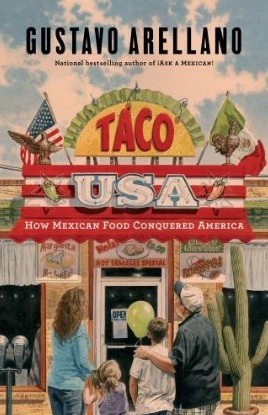
Book review: Gustavo Arellano’s “Taco USA: How Mexican Food Conquered America”

Gustavo Arellano’s Taco USA: How Mexican Food Conquered America (Scribner) is a literary feast.

Arellano covers the history of Mexican food, from its origins with the Aztecs to its present-day incarnations at Chipotle. In meticulous detail, Arellano writes about the selling of tamales on street corners, the emergence of the tortilla and salsa, and the creation of the margarita machine, among other topics.

Interestingly, some of the most prominent Mexican food – such as Taco Bell, Fritos and Paso picante sauce –was built up by Anglos. But all of the stories reveal great entrepreneurial spirit and ingenious inventions. (Sadly, his book went to press before the introduction of Doritos Locos Tacos.)

Arellano’s enthusiastic, descriptive and humorous writing makes this book so much fun to read. Check out this passage about a meal at Manuel’s El Tepeyac Café:

“There is a burrito sold in the Los Angeles neighborhood of Boyle Heights that’s beyond cosmic, that’s as close to touching God while eating Mexican food as finding Jesus on a tortilla. … Manuel’s Special: five pounds, beans and rice and guacamole and sour cream and your choice of meat – juicy nubs of grilled chicken, carne asada burned into succulent charcoal, or best with machaca, shredded beef that sticks between molars for hours afterward, heavily spiced and just grand, wrapped in a flour tortilla that, if laid flat, can serve as swaddling cloth for a puppy.”

A few quibbles: As a Texan, the book seemed a bit California-centric to me. How does the Rio Grande Valley get only one paragraph in a book about Mexican food? Although it doesn’t have the mass appeal of burritos and margaritas, I would have liked to read more about the history of pan dulce and menudo. I also would have liked to see some sociological and cultural analysis of the Americans’ seemingly contradictory anti-immigrant fervor and love for Mexican food.

The book left me hungry for that information, but it also made me hungry, literally. After reading the chapter on tortillas, I had to go to Chipotle (the closest available Mexican food place) for dinner.

Savor Taco USA. It’s as delightful as the meals Arellano describes.

More about Gustavo Arellano:

Gustavo Arellano, the editor of OC Weekly, is best known for his Ask a Mexican column. He also teaches at California State University, Fullerton.

Source: I purchased this book through Amazon.com.

1 Comment

Filed under 2012 Books, Book Reviews, Non-Fiction