Category Archives: Book Reviews

Book review: César Aira’s “The Miracle Cures of Dr. Aira”

The Miracle Cures of Dr. Aira (New Directions) by César Aira begins with the title character talking to a tree.

So begins another original novel by Argentine-based Aira, whose Varamo was released earlier this year. In this 80-page novel, Dr. Aira is a Buenos Aires doctor who believes he is being followed and filmed in pursuit of his miracle cures.

The book is funny and philosophical at times, strange and confusing at others. Take this passage that shows Dr. Aira’s paranoia – and the book’s charm:

He had developed at least one sure method for finding out if somebody was observing him: it consisted of yawning while secretly spying on the one he suspected; if he yawned in turn, it meant his eyes had been on him, because the contagious property of yawns is infallible. Of course, somebody who just happened to be looking at him at that moment might have yawned; and anyway, proof didn’t do him much good, though at least he knew what to expect, which was enough for him.

But Aira writes in long sentences that can ramble and may need to be reread. The ending may be a bit mystifying for some readers – but it’s just about what you would expect from the quirky mind of César Aira.

More about César Aira:

César Aira is the author of more than 70 novels and essays. Miracle Cures was translated by Katherine Silver.

Source: I received a review copy from the publisher.

Leave a comment

Filed under 2012 Books, Book Reviews, Fiction

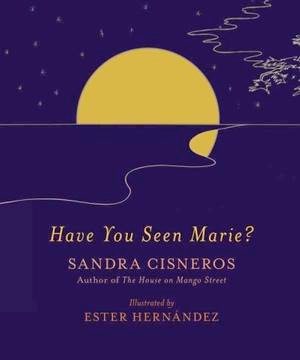
Book review: Sandra Cisneros’ “Have You Seen Marie?”

In Sandra Cisneros’ new book, Have You Seen Marie? (Knopf), the narrator searches for her lost her cat in her neighborhood. But she’s not just looking for Marie, she’s looking for a piece of herself.

The narrator lives in the King William district of San Antonio – a series of historic homes that are as colorful and unique as the people who live in them. On a hot Sunday, the narrator and a friend meet their neighbors as they search for the black and white cat who “looks like she’s wearing a tuxedo.” These eccentric group of people – a viejita who offers them a can of Big Red soda; a family of musicians who play in the park; “a girl in a fiesta dress and sleeves of tattoos” – are rendered beautifully by California-based artist Ester Hernandez.

At less than a hundred pages, Maria seems like a picture book for adults, but the book’s weight comes as the narrator realizes that she also misses her mother, who passed away a few months earlier. Marie provides a unique glimpse into a quirky neighborhood and heartfelt look into grieving.

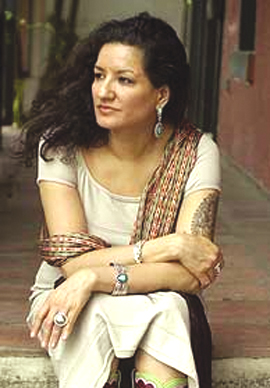
More about Sandra Cisneros:

Sandra Cisneros is best known for her 1991 novel The House on Mango Street, and her 2003 novel Carmelo. She also founded The Macondo Foundation writer’s group.

Source: I checked this book out of the library.

Leave a comment

Filed under 2012 Books, Book Reviews, Fiction

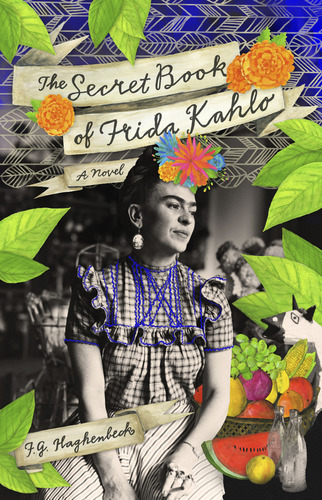
Book review: F.G. Haghenbeck’s “The Secret Book of Frida Kahlo”

Frida Kahlo loved food, elaborate skirts and Diego Rivera. But the iconic Mexican painter was haunted by death every day of her life. Mexican novelist F. G. Haghenbeck uncovers her inner life in the novel The Secret Book of Frida Kahlo (Atria).

The “secret book” refers to one of the journals found in La Casa Azul, her home in Mexico, and Haghenbeck imagines its content. Each chapter depicts a phase in her life – her childhood, her love affair with Mexican painter Diego Rivera, meetings with Ernest Hemingway and other writers in Paris – and ends with Kahlo’s thoughts and recipes.

Food plays a big role in reflecting her moods. When she lives in San Francisco and Detroit, she calls the food bland – just like the sad times she had there compared to the spicy flavors and life in her homeland. When Diego’s wife Lupe confronts her after their affair, it’s in the kitchen. As Lupe tells her, “A woman should know how to move in the kitchen so her man won’t want to eat anywhere else.” The chapter ends up becoming one of the most amusing in the book.

But the major motif of the book is death. Kahlo nearly died in a bus accident, and she made a deal with Death to sacrifice one thing each year she lives – compromises that include the loss of a child and Rivera’s constant infidelity.

Readers can feel her heartbreak thanks to Haghenbeck’s beautiful writing style, which includes great descriptions and inventive metaphors. (The book was translated by Achy Obejas.) Take this scene in which Rivera eyes Kahlo at one of their first meetings:

“He studied his interlocutor with his amphibian eyes. She smelled of fresh meat to be deliciously and vigorously devoured. She had a beautiful face, with deep eyes and charcoal hair. He noticed that her thick eyebrows met in the middle and crowned her delicate nose. He imagined them as wings of a blackbird struggling to fly.”

My only complaint: some chapters are stronger than others. But, overall, it’s a intriguing look into the mind of one of the most legendary figures in the Latino community.

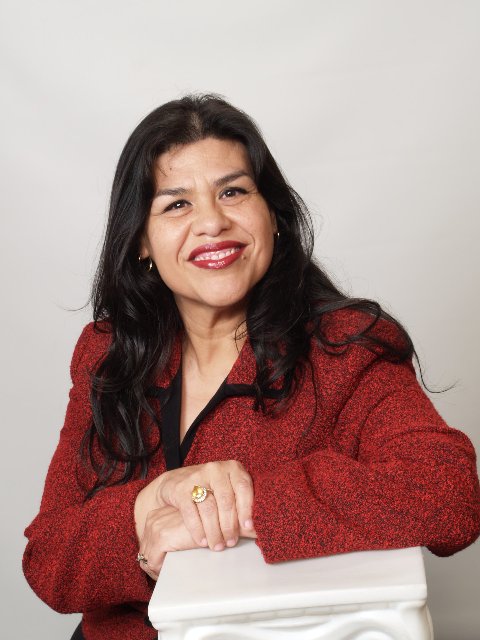
More about F. G. Haghenbeck:

F. G. Haghenbeck, who was born and lives in Mexico, is known for his crime novels, such as the award-winning Trago amargo (Bitter Drink). He also has written for Superman and other graphic novels.

Source: I received a review copy from the publisher.

1 Comment

Filed under 2012 Books, Book Reviews, Fiction

Book review: Guadalupe Garcia McCall’s “Summer of the Mariposas”

Summer of the Mariposas (Tu Books/Lee & Low Books), a young adult novel by Guadalupe Garcia McCall, combines Aztec and Mexican folklore with the plot of The Odyssey and elements from the movies Stand By Me and Weekend at Bernie’s – and it works.

Odilia, 18, and her four sisters are struggling to get by after their father has abandoned their mother. They’re enjoying a dip in the Rio Grande near their Eagle Pass home when they come across a dead body – hints of the Stephen King short story The Body and the 1986 movie Stand By Me, in which four boys look for a corpse. The sisters decide to take the body to the man’s home in Mexico with a scene reminiscent of the 1989 movie Weekend at Bernie’s, in which two men drag around a dead body.

Before they leave, La Llorona – the Mexican folklore figure who haunts waterways, crying for the children she drowned – gives Odilia advice about the journey and perils she will face in Mexico, similar to the trials Odysseus faced in Homer’s epic tale The Odyssey.

Odilia – get it? – and her sisters face a siren named Cecilia, who lures the girls with pan  dulce, and a one-eyed shepherd named Chencho. Garcia McCall also manages to get in the loteriaa quinceanera, chupacabras and the Aztec goddess Tonantzin (also referred to as the Virgen de Guadalupe) in the book. And, just like Odysseus, Odilia grows during her journey. The mariposas are in the title for a reason.

Adults may find the symbolism heavy-handed, but the book is aimed at young adults and Mariposas is a good guide to get them through The Odyssey. The book has a light, amusing touch that makes it a fun read, and young Latinos will enjoy reading about their culture.

More about Guadalupe Garcia McCall:

Guadalupe Garcia McCall won the prestigious Pura Belpré Award for her first book, the 2011 young adult novel Under the Mesquite. Born in Mexico, she now lives in Texas and teaches at a junior high school. She talked to The Hispanic Reader last year about her works and inspiration.

Source: I received a review copy from the publisher.

1 Comment

Filed under 2012 Books, Book Reviews, Fiction, Young Adult Books

Book review: Carlos Andrés Gómez’s “Man Up: Cracking the Code of Modern Manhood”

Carlos Andrés Gómez wants men to stop acting like Superman.

In his memoir, Man Up: Cracking the Code of Modern Manhood (Gotham), the spoken word poet uses his own personal experiences to show how men should be open to expressing their personal emotions, including crying and asking for help and forgiveness. As he writes:

“I was taught to wipe my tears and steady my expression as a kid. Don’t talk about what’s rumbling inside of your chest. Stay stoic and quiet. It’s part of the unspoken male code. ‘Toughen up, son,’ ‘suck it up,’ ‘man up’ – this is how we learn to process emotion. This is the cause of our emotional illiteracy. No wonder so many men bury their wounds and insecurities in alcohol and drugs and violence.”

Gómez has an interesting background. His father was from Colombia and worked for the United Nations, moving his family around the world when Gómez was young. His mother is a “traditional Southern WASPy American” with a doctorate in linguistics. His parents divorced when he was young, but Gómez earned good grades and served in leadership positions in the high schools he attended on the East Coast. After graduating from the University of Pennsylvania, he worked as a social worker and teacher.

Even more interesting is the chapter called “Sex: F—king, Making Love and F—king Up.” Earlier in the book, Gómez says he’s only slept with six women in his life. But then he describes various encounters of “hooking up” in vivid detail – how Clinton-esque of him. The chapter comes across as self-serving and hypocritical – although he later concedes that he was using “the girls.”

But the book provides some interesting insights and it becomes stronger in the end, thanks to Gómez’s well-written, easy-to-read prose. Take this passage in which Gómez describes how he healed his relationship with his father:

“When I started studying acting at twenty-three it was turning point, and I realized how impersonal all of my poems had been. Why was I so passionate and loud in my delivery of all of them? … And one day it clicked: all of those poems were about my father. I had been getting up on stage for years yelling at my father. These poems had been a vehicle to heal from the hurt I felt from our relationship. From the broken promises and the move and changing schools and the family being split apart, I was screaming with such intensity, making my throat go hoarse, because I wanted to acknowledged. More than anything else, I just wanted to be heard.”

I also enjoyed his poetry – which is included in the beginning of each chapter – and I wished the book included more of his work.

Man Up is a great book for young men to find themselves – and for women to understand a little bit about men.

More about Carlos Andrés Gómez:

Gómez has performed his spoken word poetry at more than 200 colleges around the world. He appeared in the 2006 movie Inside Man and in Russell Simmons Presents Def Poetry. Check out his performances here.

Source: I received a review copy from the publisher.

Leave a comment

Filed under 2012 Books, Book Reviews, Non-Fiction

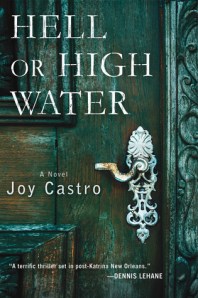
Book review: Joy Castro’s “Hell or High Water” and “Island of Bones”

Class and cultural identity are two topics that don’t get as much attention as much as they should, but Joy Castro tackles the issues in her suspense novel Hell or High Water and a book of essays, Island of Bones.

Hell or High Water (St. Martin’s Press) begins with an intriguing premise. A young woman is kidnapped from a restaurant in broad daylight. The book then turns to Nola Céspedes, a Cuban-American newspaper reporter who’s assigned to investigate sexual predators in post-Hurricane Katrina New Orleans.

The book only devotes a few passages to the kidnapping that hooks the reader. Instead, it delves into the Nola’s long interviews for her article and her personal struggles. Nola is supposed to come off as ambitious and sarcastic, but I found her snobby and pretentious, especially when she talked about her job.

“I’ve got no intention of sticking around,” she says. “The plan is to write a few knockout features, get noticed, pack my bags and then take my clips to some real newspaper in some real city.”

Well, aren’t you special? In 2008, the year the story (somewhat randomly) takes place, and even today, she would have been lucky to have any job in newspapers.

I also wanted the book to be more about the potential killer on the loose than on Nola. And as a former newspaper reporter, I found the newsroom scenes could have been so much more – which may by why I’m more critical of this book than if Nola had been a police detective or a private investigator.

Fortunately, Castro writes clearly, so the book was an easy read. And Castro is terrific at bringing up class issues that many other writers ignore. In one scene, she talks to two lower-income women about sexual predator laws.

“Neither of the women has heard of Megan’s Law. Neither knows she can access a sex-offender registry online. Neither one owns a computer.”

At the end of the book, I understood more about the decisions that Nola makes. But I wished I could have liked her more.

I liked Island of Bones (University of Nebraska Press) much better. The collection of essays covers Castro’s personal life, including a horribly abusive childhood, and her career working as the rare Latina in academia in the Midwest.

The title essay examines the stereotypes people have about Latinos, such as their faith and looks. Another great essay, “Fitting,” discusses the subtle barbs of female friendships and the importance of a good spouse.

Like her novel, Castro excels when she discusses class issues. Coming from a poor background, she is amazed at the food spreads in the faculty meetings at the college at she works.

In one of the best essays, “On Becoming Educated,” she points out how academia doesn’t reach out to everyday Latinas.

“I’m a first-generation college student, here by fluke on fellowship, and the theorists’ English seems foreign to me, filled with jargon and abstractions at which I can only guess. They say nothing about wife-beating or rape or unequal wages or child molesting, which is the charge that finally got my stepfather sent to prison. They say nothing about being a single mother on ten thousand dollars a year, which is my own situation. The feminist writers respond to male theorists – Lacan, Derrida – whose work I haven’t read. I can’t parse their sentences or recognize their allusions, and I don’t know what they mean or how they’re helpful to the strippers and dropouts and waitresses I know, the women I care abut the most, to my aunt Lettie who worked the register at Winn-Dixie and my aunt Linda who cleaned houses.”

Fortunately, in Castro, women like Lettie and Linda have someone that’s writing about them.

More about Joy Castro:

Joy Castro’s first book was the 2005 memoir The Truth Book: Escaping a Childhood of Abuse Among Jehovah’s Witnesses. She is an associate professor at the University of Nebraska-Lincoln.

Source: I checked Hell or High Water out of the library. I received a review copy of Island of Bones from the publisher.

Leave a comment

Filed under 2012 Books, Book Reviews, Fiction, Non-Fiction

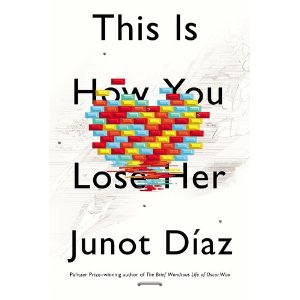
Book review: Junot Díaz’s “This is How You Lose Her”

Junot Díaz’s collection of short stories, This Is How You Lose Her (Riverhead), is absolutely brilliant – and just a tad annoying.

Most of the stories feature Yunior – a character in Díaz’s first book, Drownwho, like Díaz, was born in the Dominican Republic, immigrated to New Jersey as a child and teaches creative writing in the Boston area. All of these stories are told in Díaz’s unique voice that seems to be speaking to you like you’re his best friend. The voice is tormented, cynical and, to the reader, entertaining to read.

The book shows Yunior in different phases from his life, including one story (“Invierno”) from his childhood in which he is fascinated by the snow and disillusioned by his father: “I had expected a different father, one about seven feet tall with enough money to buy our entire barrio, but this one was average height, with an average face.”

But, most of the time, Yunior always seems to be breaking up with a woman or in some sort of relationship drama. “And that’s when I know it’s over,” Yunior says in “The Sun, the Moon, the Stars.” “As soon as you start thinking about the beginning, it’s the end.”

In “The Pura Principle” Yunior’s brother, Rafa, has been diagnosed with cancer. It’s one of the best stories in the book, and it has some of the best lines, such as when their mother turns to religion: “She’d never been on big on church before, but as soon as we landed on cancer planet she went so over-the-top Jesucristo that I think she would have nailed herself to a cross if she had one handy.”

An abusive partner is described as “a two-year-long PSA,” and a new friend is termed as “fresh-off-the-boat-didn’t-have-no-papers Dominican.”

And there’s this: “Pura was her name. Pura Adames. Pura Mierda was what Mami called her.”

While it’s a great line, that sentence also represents the book’s one flaw. Many of the women are portrayed as lying sluts. Yunior is not a saint himself, but I’d wish the women were more multidimensional, such as in “Miss Lora”,  in which Yunior has an affair with an older woman, or in “Otra Vida, Otra Vez,” about an immigrant who works in a laundry room and waits for her family to call every Sunday.

(Díaz’s frequent use of the “F” and “N” words also may turn off some readers, although I understand that language is a reflection of the working class lives portrayed in the stories.)

But then, in the last story in the book, “The Cheater’s Guide to Love,” Yunior begins to grow up after his girlfriend catches him cheating on her and dumps him. You feel for Yunior because Díaz captures the pain of a broken heart so well – it’s slow, it’s hard, and it’s painful. It’s the perfect ending to a great book.

More about Junot Díaz:

Díaz is the author of the 1997 short story collection Drown and the 2008 novel The Brief Wondrous Life of Oscar Wao, which won the Pulitzer Prize for Fiction.

Source: I received a review copy from the publisher.

3 Comments

Filed under 2012 Books, Book Reviews, Fiction

Book review: Las Comadres Para Las Americas’ “Count on Me: Tales of Sisterhoods and Fierce Friendships”

Count On Me: Tales of Sisterhoods and Fierce Friendships (Atria) is the perfect gift to give to your best friend.

The book of essays was put together by the non-profit association Las Comadres Para Las Americas and edited by Adriana V. Lopez. In a dozen essays, 11 prominent Latinas – plus Luis Alberto Urrea – talk about the power of female friendship. Some of the friends make extraordinary gestures. Carolina de Robertis, author of Perla, edits a deceased friend’s book. A teacher offers shelter to Reyna Grande, in an excerpt from her memoir The Distance Between Us, after she faces a bad family situation. Lorraine López receives advice from writer Judith Ortiz Cofer to pursue her literary career – leading to such books as The Realm of Hungry Spirits.

But two of the best essays are those that acknowledge that a best friend can often be your worst enemy. In “Anarchy Chicks,” Michelle Herrera Mulligan describes how adolescent friends go weeks without talking to each other, then become best friends again with a single phone call. In “The Miranda Manual,” Sofia Quintero nails all the subtle gestures and actions that can destroy a relationship:

“There were no betrayals or putdowns, no angry emails or shouting matches, breaches of confidences or rehashing of past misdeeds. Neither of us committed a gross act of deliberate hurt against the other. Rather, we engaged in tiny yet relentless acts of thoughtless toward each other. The little digs, constant interruptions and the passive listening typical of mere acquaintances that’s easy to ignore. When the person is usually mindful and considerate best friend, it hurts like hell.”

Most of the essays are excellent. Dr. Ana Nogales’ essay is too general to make an emotional impact, but she describes the health benefits to friendships. But Teresa Rodríguez sums up the power of friendship in her essay about activist Esther Chávez Cano:

You see, a comadre is not necessarily a close friend, but a person whose example is etched in your heart. The one you’d like to emulate, that friend who gave so much of herself and asked for nothing in return.

Source: I received a review copy from the publisher.

Leave a comment

Filed under 2012 Books, Book Reviews, Non-Fiction

Book review: Reyna Grande’s “The Distance Between Us”

Reyna Grande’s memoir The Distance Between Us (Atria) should come with a box of tissues.

Grande grew up in the 1970s in Iguala, Mexico, a small town whose mountain has a mysterious force on its other side that residents call El Otro Lado – the United States.

Grande’s parents left Reyna and her two older siblings behind with their grandparents so they could work at better paying jobs and build a new home in Iguala. But as Grande describes it, the separation took a toll on the family as the children live in squalor.

“… the banks lined with trash and debris floating in the water, the crumbling adobe houses, the shacks made of sticks, the children with worm-pregnant bellies running around with bare feet, the piles of drying horse dung littering the dirt road, the flea-bitten stray dogs lying under the shade of trees, flies hovering above them. But what I saw back then I saw through the eyes of a child – a child who had never been anywhere, a child who was still innocent enough to see past the things later in life she could not. What I saw the were the velvety mountains around us, the clear blue sky, the beautiful jacaranda trees covered in purple flowers, bougainvilleas crawling up fences, their dried magenta petals whirling in the wind. … I continued to think that there was beauty everywhere around us. … But when … I saw mothers and fathers strolling about holding hands with their children, I realized that it didn’t matter what I thought of Iguala. Without my parents here, it was a place of broken beauty.”

At age 10, Grande and her siblings crossed the border illegally and moved to Los Angeles to be with her parents. But life is just as tough there as her mother ignores her and father becomes abusive toward her and her siblings.

But her father also was her best motivator, emphasizing the importance of a good education. Grande earned good grades and became a top musician in her school’s marching band. Federal legislation in 1986 enabled her to become a legal citizen.

A teacher in junior college encouraged her to write – leading Grande to write this incredible book. Told in simple, easy to read – yet descriptive – prose, my heart broke as I read about all that Grande suffered through. The Distance Between Us is an inspirational book for young Latinos or anyone who has faced adversity. Just keep those tissues handy.

More about Reyna Grande:

Reyna Grande is the author of the novels Across a Hundred Mountains and Dancing with Butterflies.

Source: I received a review copy from the publisher.

Leave a comment

Filed under 2012 Books, Book Reviews, Non-Fiction

Book review: Carlos Ruiz Zafón’s “The Prisoner of Heaven”

Carlos Ruiz Zafon’s The Prisoner of Heaven (Harper Collins) is a good escape about a great escape.

Daniel Sempere is a bookseller in Barcelona when, on Christmas 1957, he is visited by a stranger who has information about his friend, Fermín Romero de Torres. Fermín then is forced to reveal a secret from his past life.

He was imprisoned in the 1940s, where his cellmate, a writer named David Martín, had strange, delusional ramblings that earned him the nickname “The Prisoner of Heaven” and may have ties to Daniel.

Fermín feels trapped. He desperately wants to escape the horrendous conditions of the prison that, under the Franco dictatorship, is run by a governor with strong personal ambitions. His plan has the audacity of Andy Dufresne in Stephen King’s The Shawshank Redemption.

Prisoner is the third in the Cemetery of Forgotten Books series, following 2004’s The Shadow of the Wind and 2009’s The Angel’s Game, although you don’t have to read them in order. I haven’t read the two previous books, and I didn’t feel lost.

But I had high expectations for Heaven. Book bloggers on Twitter were buzzing about the book, apparently since Shadow is so good.

And Heaven is an entertaining book. The main characters are easy to like, and the plot kept me reading. But I was expecting more – something with the unputdownable pace and intrigue of Dan Brown’s Angels and Demons. (Don’t roll your eyes. I know it’s lowbrow, but that book is awesome.)

Heaven doesn’t reach that high of a level, but it’s still a good read.

More about Carlos Ruiz Zafón:

Carlos Ruiz Zafón is the author of six weeks, including several young adult novels. He lives in Barcelona and Los Angeles.

Source: I purchased this book through Amazon.com.

1 Comment

Filed under 2012 Books, Book Reviews, Fiction